Versioning Agent Configs With GitOps Workflows
Treat agent config like infrastructure code to safely govern credentials and tool access.
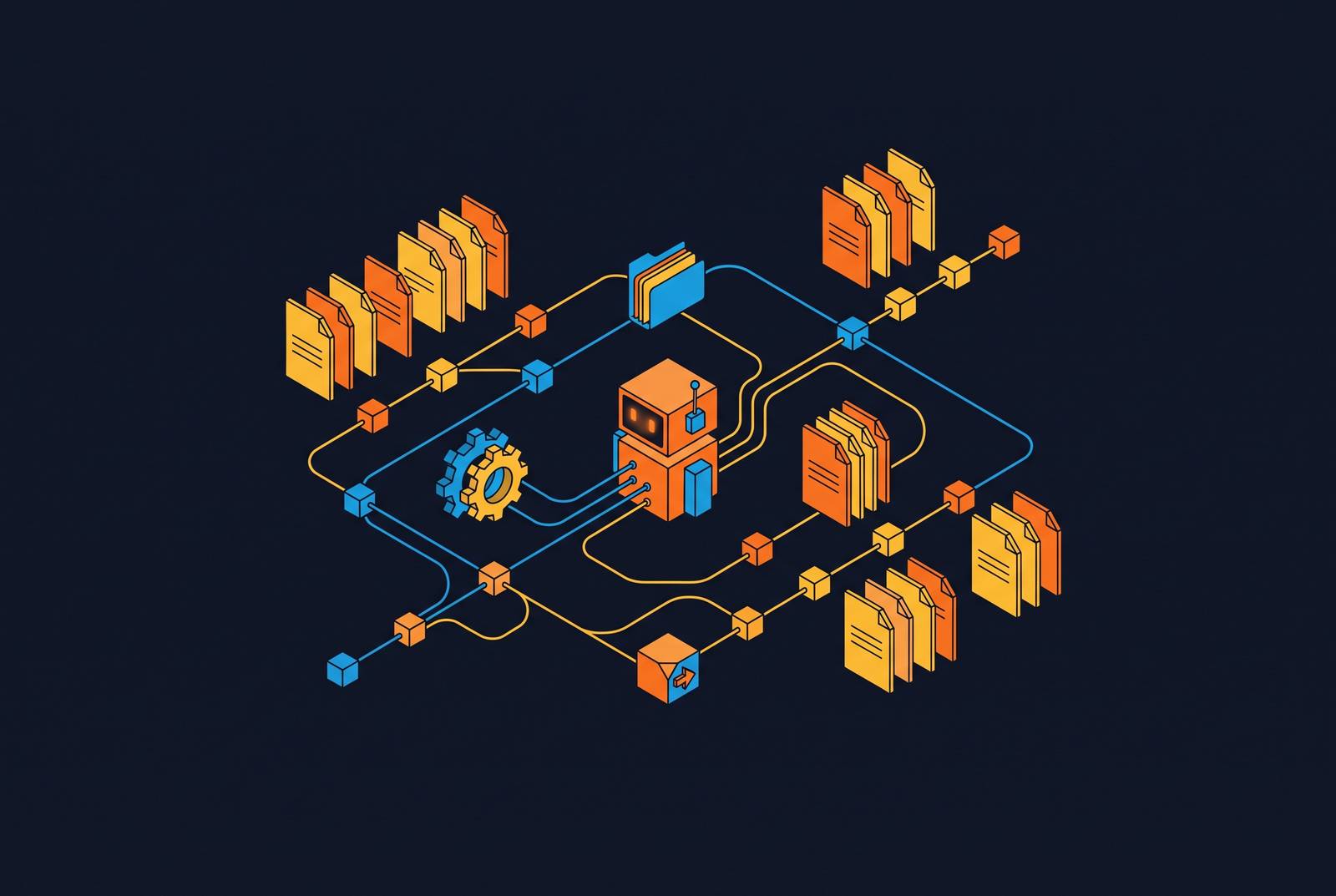
Agent configuration is starting to move where application code already lives: version control, pull requests, CI gates. The shift matters because agents in production hold credentials, spend money, and make tool calls on their own, and none of that can be safely governed through a settings page or a Slack message telling someone to "just bump the limit." This piece lays out the specific mechanics of treating agent config as a GitOps artifact: how it's structured, how it's reviewed, and what happens when it drifts from what's declared.
The context is a real shift in what coding agents do. Through 2023 and 2024, the dominant pattern was completion: a suggestion in an editor, a snippet a developer accepted or rejected line by line. The human held every decision. By 2026, agents are doing full tasks unsupervised, writing and submitting code, triaging issues, running database migrations, with a human specifying the goal and verifying the result rather than performing the work directly. That's a different risk category entirely. An agent that suggests text can't overspend a budget or leak a credential. An agent that acts can do both, continuously, without anyone in the loop until something breaks.
What GitOps actually means when applied to agent configuration
GitOps, in its original form, is a simple idea with serious operational teeth. Desired system state gets declared in a versioned, immutable source, typically a Git repo, and an automated reconciliation process pulls that state and applies it to whatever's actually running. This pattern was built for Kubernetes because manual state management at that scale had become impossible; nobody could reliably track what was deployed where by hand anymore. Git became the only interface for describing and updating the system. Not a dashboard, not a shell session on a production box. Git.
Applying that model to an AI agent means treating its behavior as declared state rather than runtime improvisation. Which model it calls. What tools and external services it's permitted to invoke. What credentials it holds and for how long. What budget it can burn per session and per billing period. What triggers it and what it's expected to produce. All of that gets written as YAML and checked into a repository next to the application code the agent actually touches.
The behavioral shift this forces is the important part. No live edits in production. No portal changes made at 2am during an incident. No configuration that exists only in the memory of a running process. Every change to what an agent can do travels through a pull request, which means it can be diffed, reviewed, and rolled back by anyone with repo access, the same mechanics that made infrastructure-as-code trustworthy in the first place. A concrete version of this already exists in practice: project-level instruction files committed at the root of a repo get reviewed exactly like any other file. The agent's intent stops being tribal knowledge and becomes something a reviewer can read.
How YAML-defined agent configs live inside a repository in practice
The repository becomes the single source of truth. Agent config sits alongside application code, infrastructure definitions, and CI configuration, subject to the same code-ownership rules and review conventions that already govern everything else in that repo.
A properly structured agent config file captures several distinct things. Trigger conditions define what event, schedule, or API call wakes the agent up. Task scope defines what it's supposed to do, and, just as importantly, what's explicitly off-limits. Tool permissions list which integrations it's allowed to call, with parameter constraints where needed. Credential references point to scoped secrets rather than embedding values directly; the actual credential gets minted at runtime and revoked when the session ends. Budget limits set a per-session token ceiling and a per-period spend cap. Escalation and halt rules define the conditions under which the agent stops and asks a human to look, rather than pressing forward on its own judgment.
Agents-as-code is maturing as a pattern in its own right, with teams moving toward formats that declare triggers, compute allocation, and guardrails directly in files rather than through UI toggles or values hardcoded into a script somewhere. Co-locating the agent config with the application code matters because the two evolve together. A pull request that changes an API endpoint should, in the same diff, update the config that defines what the agent is allowed to do with that endpoint. Naming conventions help too: one agent per file, human-readable names, an explicit version field, so a reviewer can understand what changed without spinning the agent up to find out.
The PR workflow as the change-control mechanism for agent behavior
Change control for an agent means exactly this: any modification to what it's allowed to do, a new tool permission, a relaxed budget cap, a changed trigger, has to go through a pull request. Not a direct edit to a running config.
The PR is where intent gets written down in the description, where risk becomes visible in the diff, and where approval gets recorded through review, all before the change reaches anything live. That diff is the governance artifact. When a reviewer can see a budget cap moved from one number to a higher one, or that a new external API got added to a tool list, the change becomes something that can be discussed and reversed. A setting changed in a portal offers none of that; it just happens, and the previous state is gone unless someone happened to screenshot it.
CI gates give this teeth. Schema validation checks whether the YAML conforms to the expected structure. Policy checks catch violations of standing guardrails, no agent config may request write access to production secrets, for instance. Automated behavioral tests can run the agent under the new config in staging before the PR ever merges, catching a bad change before it reaches production rather than after.
Merge conflicts do useful work here too. When two branches modify the same permission scope or the same escalation rule, the conflict surfaces at merge time instead of one change silently overwriting the other in a live system. And because every version is a commit, rollback is a revert, not a manual reconstruction of what the config used to say from memory or an old screenshot. In regulated environments, that review trail isn't a nice-to-have. It's evidence: who approved a change to an agent's permissions, when, and for what stated reason.
Configuration drift and why it is a specific, named failure mode for agent systems
Configuration drift is what happens when the live agent no longer matches what the repo says it should be, because someone made a direct edit, a portal change, or an emergency patch that never got committed back.
Drift is a known problem in conventional infrastructure, but it's more dangerous with agents. A drifted server config just sits there, inert, until the next deployment cycle catches up to it. A drifted agent config is shaping decisions being made right now. An agent running on undeclared configuration might be using a different model than the one on record, holding broader permissions than approved, or operating under a budget cap someone relaxed during an incident and forgot to write down. None of that shows up in the audit record, because the audit record only knows about what's declared.
Drift tends to enter quietly. A credential gets rotated directly and the config file never gets touched. A prompt gets adjusted in a UI to patch an incident fast. A model version gets bumped through a provider's portal under pressure, with the intention of "fixing it properly later" that never quite arrives. The field's growing investment in scheduled drift detection tooling is a signal worth noting: practitioners now treat this as a production-grade operational concern, not an edge case for the paranoid.
Detection patterns that pair well with GitOps include scheduled reconciliation jobs comparing declared config against observed runtime state, and alerting on any session whose tool calls, model choice, or budget consumption diverges from what was declared for it. The deeper goal isn't just catching drift after the fact. It's making undeclared configuration impossible to deploy in the first place, which is what a platform enforces when the config file is the only path to deployment, full stop. Some managed cloud runtimes for coding agents, such as Ellipsis, a cloud infrastructure layer that runs Claude Code and Codex in isolated sandboxes with YAML config files as the sole definition of agent behavior, are built around exactly this constraint.
How token budget policies belong in the same YAML that defines agent behavior
Agentic workloads have a cost profile that looks nothing like a chat interface. A chatbot calls the model once per turn. An agent calls it repeatedly across a task loop, tool call, observation, next tool call, round-tripping through the LLM every step, and multi-agent architectures multiply that further as subagents spin up their own loops.
The canonical failure is a runaway loop with no ceiling. A bug, an unexpected input, a tool that returns something the agent misinterprets as a reason to keep going, and token consumption can climb fast before anyone's watching. Without a hard limit, that's not a performance problem, it's a billing event.
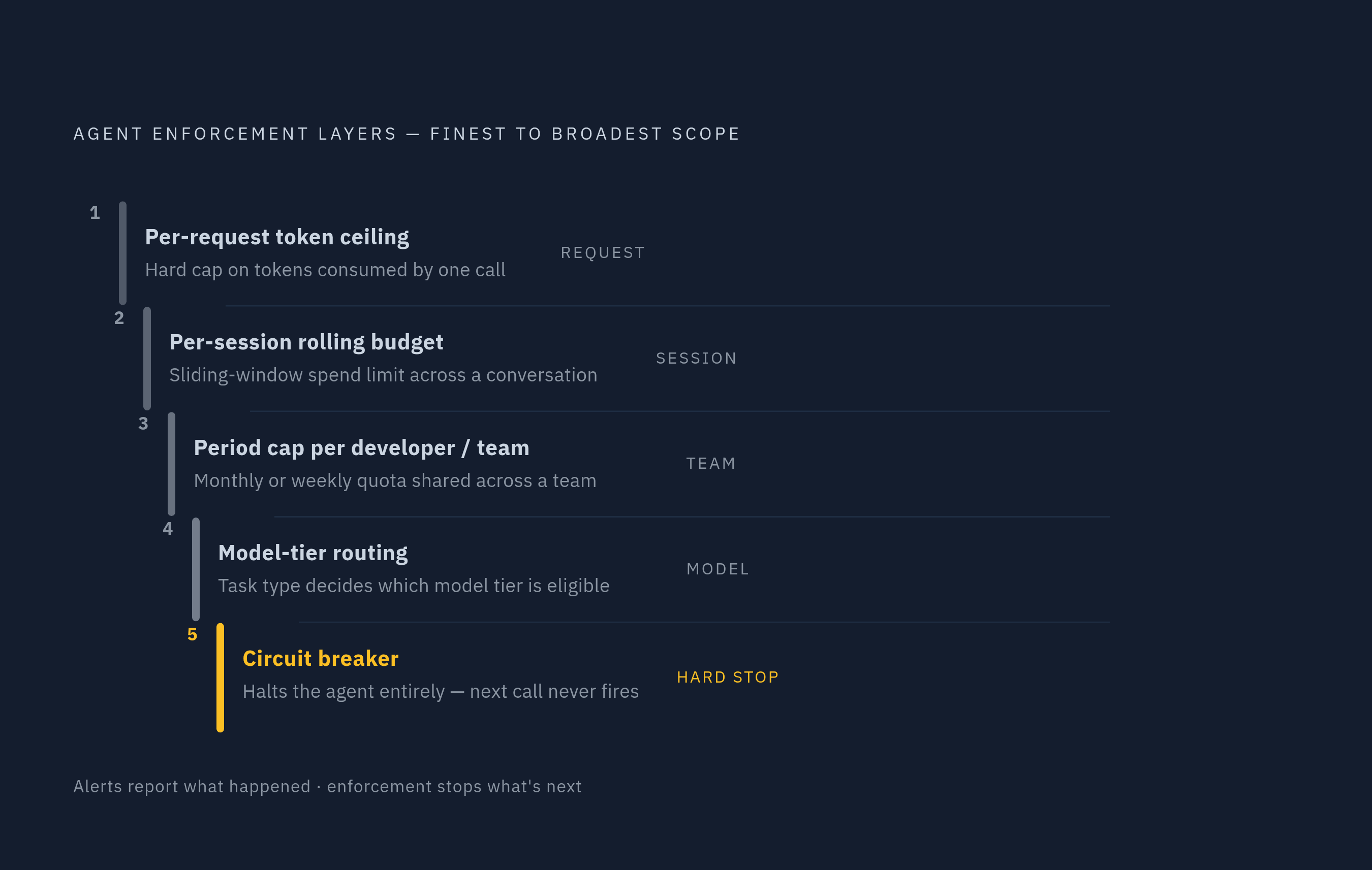
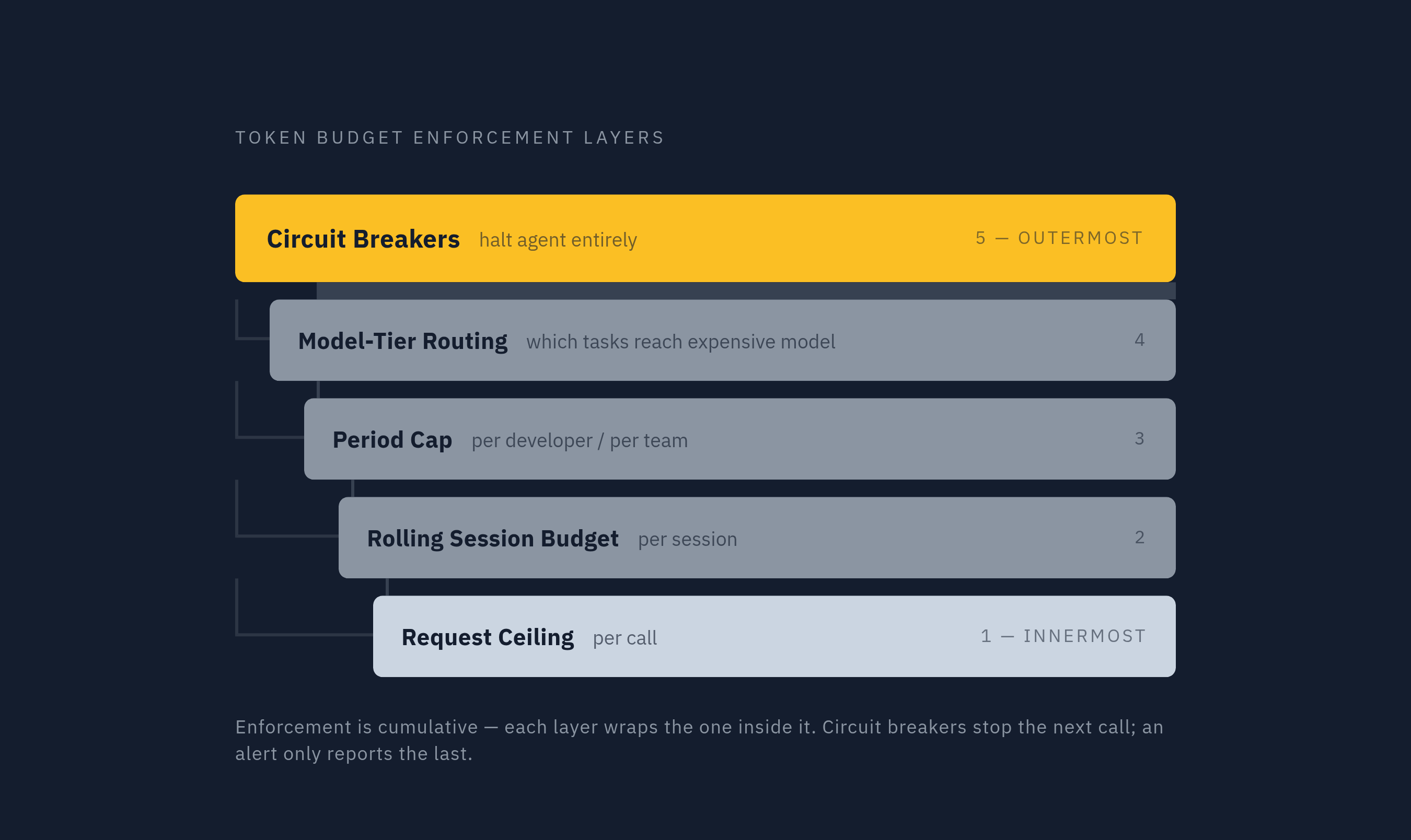
Alerts and enforcement are not the same control. An alert tells someone spending happened, after the fact. Enforcement stops the agent from making the next call at all, until a human or a policy resumes it. And enforcement has to live at the infrastructure layer, not inside the agent's own reasoning, because an agent that's misbehaving can't be trusted to police itself.
Five layers of budget control belong in the config file: a per-request token ceiling, a per-session rolling budget, a per-developer or per-team period cap, model-tier routing rules that dictate which task types get access to the more expensive model, and circuit breakers that define when the agent halts outright. Raising a budget cap is a policy decision, and it should carry the same weight as a permission change: a PR, a reviewer, a commit message that says why. The diff becomes the cost governance record, showing exactly when a limit moved, who approved it, and what justification was given, rather than something reconstructed weeks later from a billing dashboard nobody checked in time.
Scoped credentials and per-session identity as config-enforced security properties
Traditional identity and access management was built for humans and for static service accounts that don't change much over time. Agents are neither. They need credentials scoped to a specific task, alive only for the duration of a session, and revoked automatically when that session ends.
ISACA's 2025 guidance is direct on this point: every AI agent should be provisioned as a named service account, and shared credentials across multiple agents count as an audit finding. The old habit of one API key for "the bot" isn't just sloppy anymore; it fails a SOC 2 review outright.
The config file is where this gets declared. Which secrets an agent may request, referenced rather than embedded as raw values. The scope of that access, read-only against a resource versus write, and which specific resources are in bounds. The session lifecycle, credentials minted when the session starts and revoked the moment it completes. This has to sit at the infrastructure layer rather than being trusted to agent judgment, because an agent will use whatever access it's been given. OWASP's work on agentic application risks identifies tool misuse through overly permissive configuration as its own risk category for exactly this reason. Limiting access is the control; there isn't a second layer behind it.
Multi-agent systems add a compounding risk. Prompt injection can propagate down a chain of agents, and implicit trust between peer agents can turn into privilege escalation if one link in that chain gets compromised. Per-agent identity and scoped credentials are the architectural answer, not a hygiene suggestion. The same logic extends to the runtime layer itself: YAML security policies can declare what files can be read, what network calls are permitted, what commands are allowed to run, the same declarative, reviewable structure GitOps applies to everything else. The config file becomes the least-privilege boundary, and the useful question a reviewer can ask before merging is whether this agent actually needs write access to this secret for this task, rather than finding out the answer was no after an incident.
The audit trail that GitOps creates — and why regulators are starting to require it
Applied consistently, GitOps produces a complete audit trail almost as a side effect. Git history records every config change, who authored it, who approved it, when it merged. CI logs record every automated check that ran against that change before it went live. Session logs record every tool call, every diff, every token consumed, attributed to the specific config version that was active at the time.
That attribution is the whole point. When something goes wrong, "what was the agent configured to do, and who approved that" has a definitive answer sitting in Git, not a reconstruction pieced together from memory and scattered logs.
Regulation is catching up to this reality. The EU AI Act is phasing in obligations for general-purpose AI models through 2025 and 2026, and frameworks like it require demonstrable, technical enforcement of AI policy, not a policy document sitting in a compliance folder that nobody's system actually checks against. Survey data suggests a large share of organizations still lack a formal strategy for governing AI agents, which means the technical audit trail a GitOps workflow produces often outpaces what the rest of the organization's governance program can actually show an auditor. The PR review requirement, that a meaningful change gets looked at by at least one other person before it ships, maps naturally onto the kind of documented human oversight that emerging regulatory frameworks are beginning to demand.ral regulated industries by design, not by retrofit. The config record says what the agent was allowed to do; the session log says what it actually did. Together, they close the loop between stated policy and observed behavior, which is the thing regulators are actually asking for.
Agents that make GitOps commits — the second-order governance problem
The pattern now emerging is agents that don't just operate under GitOps governance but participate in it directly, opening their own pull requests to modify configuration, including, in some designs, their own. An agent that notices its budget cap is too tight for a recurring task might propose raising it. An agent managing a fleet of subagents might commit a change to another agent's tool permissions.
That collapses a distinction the whole framework depends on: the reviewer and the reviewed are supposed to be different parties. A PR workflow assumes a human, or at least an entity outside the system being changed, is checking the diff before it merges. An agent proposing changes to agent config is still just a proposal, provided a human or a separate policy engine remains the actual approver; the moment that approval step is delegated to another agent, the audit trail stops recording oversight and starts recording one automated system rubber-stamping another. Whether that second-order layer gets the same review rigor as the first is the open question the field hasn't settled yet, and it's the one worth watching most closely as these systems mature.