GitHub Webhook Events That Should Trigger Coding Agents
Selective webhook filtering prevents coding agents from wasting compute on low-signal events.
Roughly 40% of enterprise applications will embed task-specific AI agents by the end of 2026, up from under 5% in 2025. That growth turns a design question that used to be theoretical into an operational one: teams have to decide not whether to hook agents into a development pipeline, but exactly which signals should be allowed to wake one up. GitHub already emits the raw material for that decision as structured events. A pull request opens, a test suite fails, an issue gets labeled: each is a machine-readable fact with a known shape and known context attached.
Most teams get the default wrong, and they get it wrong in the same direction every time. The instinct is to subscribe to the full event stream, let the agent sort out what matters, and call the job done. That approach burns compute on events that carry no signal, drives up the bill for a coding agent's inference and tool calls, and floods the review queue with commentary nobody asked for. Noise here doesn't just cost money, it degrades output, because a system asked to react to everything ends up deciding nothing well. Treat this as triage, not surveillance. An event earns a trigger only when it carries enough context about a discrete unit of work, and enough urgency, to justify spinning up an autonomous run.
What makes a GitHub event a good agent trigger
Three properties separate a usable trigger from noise, and most misconfigured pipelines fail at least one of them. First, sufficient context: the payload has to describe what changed and why. A bare push SHA tells an agent almost nothing on its own, but a pull request with a diff, a title, a description, and a linked issue tells it plenty.
Second, actionability. A good trigger implies a bounded response, something like "review this diff" or "triage this issue," rather than a vague notification that an event occurred somewhere in the repository. Third, proportionality: the latency and cost of running an agent session has to be worth the value produced at that moment. Firing a full agent run to acknowledge a star on the repo fails this test immediately, and any team doing that today should stop doing it this week.
Configure only the events the workflow actually needs. GitHub lets an integration subscribe selectively, and that selectivity is the whole game. Sending every repository activity to a webhook endpoint and filtering downstream throws away the one advantage webhooks have over polling: they fire only when something specific happens. Add two more gates before a run ever spawns. Label gating restricts execution to issues or pull requests explicitly tagged for agent handling, so the system doesn't fire on every new item that lands in the tracker. Signature verification confirms the delivery actually came from GitHub, since a public endpoint without that check can be triggered by anyone who finds the URL.
Polling checks repository state on some interval and reacts to whatever changed since the last check. It was never the right model for this problem. Event-driven triggers activate within milliseconds of the underlying GitHub action, cost less compute because there's no idle checking loop, and match how GitHub's webhook architecture is built to be consumed. Treating webhooks as an optional upgrade rather than the baseline gets the cost structure backward from the start.
Pull request events: the highest-signal trigger category
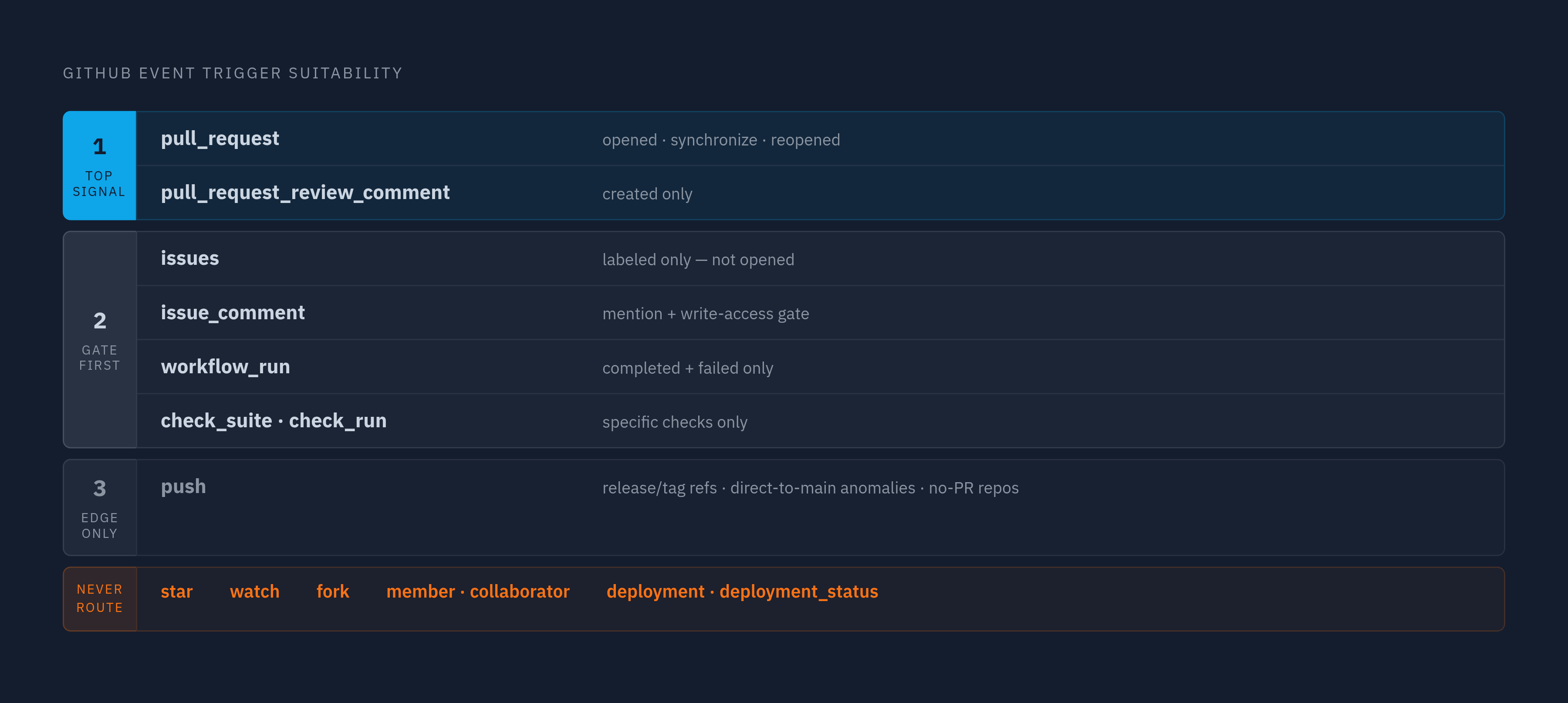
The pull_request event, filtered to the types opened, synchronize, and reopened, is the strongest trigger available on the platform. It should be the default starting point for any team building this out, not one option among several. Each of these carries the full diff, the PR title and description, links to related issues, and both the base and head branches, enough for an agent to do something a human reviewer would recognize as a real code review.
On opened or reopened, the agent's job is to inspect the changed files for defects, maintainability problems, and security issues, check the changes against whatever coding standards or architecture rules the repository documents, and post a structured review comment. The agent surfaces findings; a human still owns the merge button, and any configuration that blurs that line is a mistake worth reversing immediately.
Synchronize deserves separate handling. That event fires when new commits land on an already-open PR, and the correct response is to re-review only the incremental diff. Re-reviewing everything on every push wastes compute and buries the PR thread in duplicate comments. The agent should also confirm that earlier review feedback actually got addressed in the new commits.
Pull_request_review_comment, filtered to created, stands apart as its own sub-trigger. This fires when a comment is left on a specific line of the diff. It's a natural handoff point: the agent implements the requested change and pushes a follow-up commit, closing the loop without the PR author having to stop what they're doing and context-switch back into the review thread. A comment thread is an easy place to smuggle in instructions, so restricting execution to trusted contributors by default is the safe posture. Explicit allowlists (allow-users, allow-bots) should govern any exception, so an arbitrary PR author can't inject a prompt through a comment and get the agent to act on it.
CI failure events: turning a broken build into an automatic fix attempt
The relevant trigger here is workflow_run, scoped to completed runs that ended in failure. The agent spins up only when a build actually breaks, never on a green run.
Once triggered, the agent reads the failure output and logs from the failing workflow, works backward from the error to the specific commit that introduced it, and applies a fix scoped narrowly to the failing tests. This is not an invitation for a broader refactor. An agent configured to "clean up while it's in there" is a liability, not a feature, and the output should be a draft pull request for human review rather than a direct commit. That distinction, draft PR versus direct commit, is what keeps an automatic fix attempt from becoming an unreviewed change to production code.
check_suite and check_run events offer an alternative path, useful when only specific checks, a security scanner or a type checker for instance, should trigger a response, rather than treating any CI failure the same way.
Timing constraints shape how this has to be built. GitHub closes out a webhook delivery if the receiver doesn't respond within 10 seconds. Separately, infrastructure like Railway's edge closes an HTTP connection after 5 minutes with no data flowing (up to 15 minutes if data keeps moving). The receiver needs to answer fast and hand the actual work off to a background process. The agent's real diagnostic and fix-writing work runs asynchronously, well outside that 10-second window.
Issue events: the case for label-gating before spawning a run
The issues event, with types opened, labeled, and assigned, is where the temptation to over-trigger runs strongest, and it's where most teams get burned. Raw opened is too broad on its own. It fires equally on well-specified feature requests, vague bug reports, one-line questions, and outright spam.
The fix is a label gate. Only issues explicitly tagged with the agent's designated trigger label, something like agent-ready or codex, should spawn a run. That gate does something organizationally useful too: it puts a human in the loop before the agent ever runs, since someone with repository access has to apply the label, which functions as implicit approval for the agent to engage. Trigger on labeled, not opened, and keep that filter explicit every time rather than buried in downstream logic where it's easy to forget or override.
Once a labeled issue triggers a run, the agent's job depends on how well-specified the issue is. For issues with clear acceptance criteria and reproducible steps, the agent can explore the repository for context, write a fix, and open a pull request directly, converting an issue into a PR without any new tooling required. That's a well-established pattern in agent-assisted development workflows. For underspecified issues, the better move is a structured clarifying comment rather than a fix attempt built on guesswork. An agent that guesses anyway is worse than one that asks.
A separate pattern applies to issue_comment, filtered to created. This fires on any comment on any issue, which makes it useless without a mention gate: the agent should only act when explicitly mentioned, something like @codex or @copilot, by someone who holds write access. Skipping that gate turns every comment on every issue into a trigger, as high-noise and high-cost a configuration as this list contains.
Push events: narrow use cases most teams should skip
The push event fires on every commit pushed to main, a feature branch, a bot branch, or a release branch. Volume alone makes this a poor default trigger. A repository with a handful of active contributors generates push events constantly, and triggering a full agent run on each one gets expensive fast while producing more review comments than any team wants to read.
Context is the deeper problem, though. A push payload contains refs and commit SHAs but not the intent behind the change. Intent, description, and the list of reviewers live in the pull request. Redundancy is built in besides: a push to a branch with an open PR typically surfaces through the pull request event pipeline, so the PR event covers the review use case without a separate push trigger doing the same job twice. Most teams that wire up push triggers alongside pull_request triggers are paying twice for one signal, and that duplication is worth ripping out rather than tolerating.
Push events earn their place in narrower circumstances. A push to a release or tag ref marks a genuinely meaningful moment, a new version landing, and a reasonable agent response there is changelog generation, a dependency audit, or a deployment readiness check. A push directly to main or another protected branch, bypassing the PR process entirely, is an anomaly the agent can summarize or route for review. And in repositories where every contributor pushes straight to branches without ever opening a PR, small teams and monorepo scripts being the obvious case, push is simply the only signal that exists.
The rule holds without much exception: if the team works through pull requests, trigger on pull request events, full stop. Reserve push triggers for workflows where PRs never enter the picture, or for tag events whose semantic meaning would otherwise come from a PR that doesn't exist.
Events worth explicitly excluding from agent routing
Some events should never reach an agent, and the case for excluding them isn't close. Star and watch events generate high volume and carry zero actionable context; routing them anywhere near a coding agent produces no engineering value. Fork events are purely informational: no code has changed, and no unit of work has been scoped by the act of forking.
Member and collaborator events represent administrative state changes rather than a coding task, and they belong in a log or an audit system. Deployment and deployment_status events sit in a similar category: they represent a pipeline outcome rather than a discrete unit of coding work, and they rarely carry enough standalone context for a coding agent to act on without pulling in additional state from elsewhere. Wiring any of these four straight into an agent run is a configuration error, not a judgment call, and it should get fixed the moment someone spots it in a workflow file.
Signature verification and access control as prerequisites for any trigger configuration
None of the event selection above matters if the endpoint receiving these webhooks is exposed without verification. A publicly accessible webhook endpoint that skips signature checking accepts events from anyone who stumbles onto the URL, and an agent sitting behind that endpoint processes fabricated events just as readily as real ones: triggering real API calls, real branch writes, real comments on real issues.
GitHub signs every webhook delivery with the X-Hub-Signature-256 header, computed via HMAC. Verifying that header before doing anything else with the payload is the floor, not an optional hardening step for later.
For issue and comment triggers specifically, a two-gate model holds up well. The first gate is the signature check: only deliveries GitHub actually signed get processed. The second gate is the label or mention check layered on top: only payloads matching the agent's designated label or @-mention get routed into an actual run.
Access control has to extend down to the runner level too. The safe default restricts agent-triggering actions to users with write access, and any expansion beyond that should happen through explicit allowlists (allow-users, allow-bots) rather than opening the trigger to every commenter indiscriminately. Skip that boundary and any pull request author can inject arbitrary instructions through a commit message or an issue body, a prompt injection vector that costs nothing to exploit and everything to clean up after.
Running event-triggered agents in isolated, governed infrastructure
Knowing which events to trust is half the problem. Infrastructure is the other half, and it's the half most teams underestimate. GitHub fires webhooks for pull requests, issues, and pushes without much ceremony, but turning that raw event stream into reliable agent automation means handling signature verification, retry logic, payload transformation, routing rules, timeout management, and durable task execution, all before the agent does a single useful thing. That's a lot of infrastructure to build for what is, at its core, application logic.
The 10-second response window GitHub enforces on webhook deliveries shapes the whole architecture around this problem. Whatever receives the event has to answer fast, and the agent's actual task, which might run for a long stretch depending on what it's diagnosing or fixing, has to happen somewhere else entirely: isolated, monitored, and cleanly separated from the thin receiver that exists only to acknowledge GitHub and hand off the real work. Get that separation wrong and the whole pipeline behaves like a fragile script waiting for its first timeout. Get it right, and an event-triggered agent starts behaving like what it actually is: dependable engineering infrastructure, not a demo that happened to survive its first week in production.