Compliance Audit Logs for Coding Agents in SOC 2 Environments
Auditors now treat coding agents as privileged accounts requiring full access controls and logging.
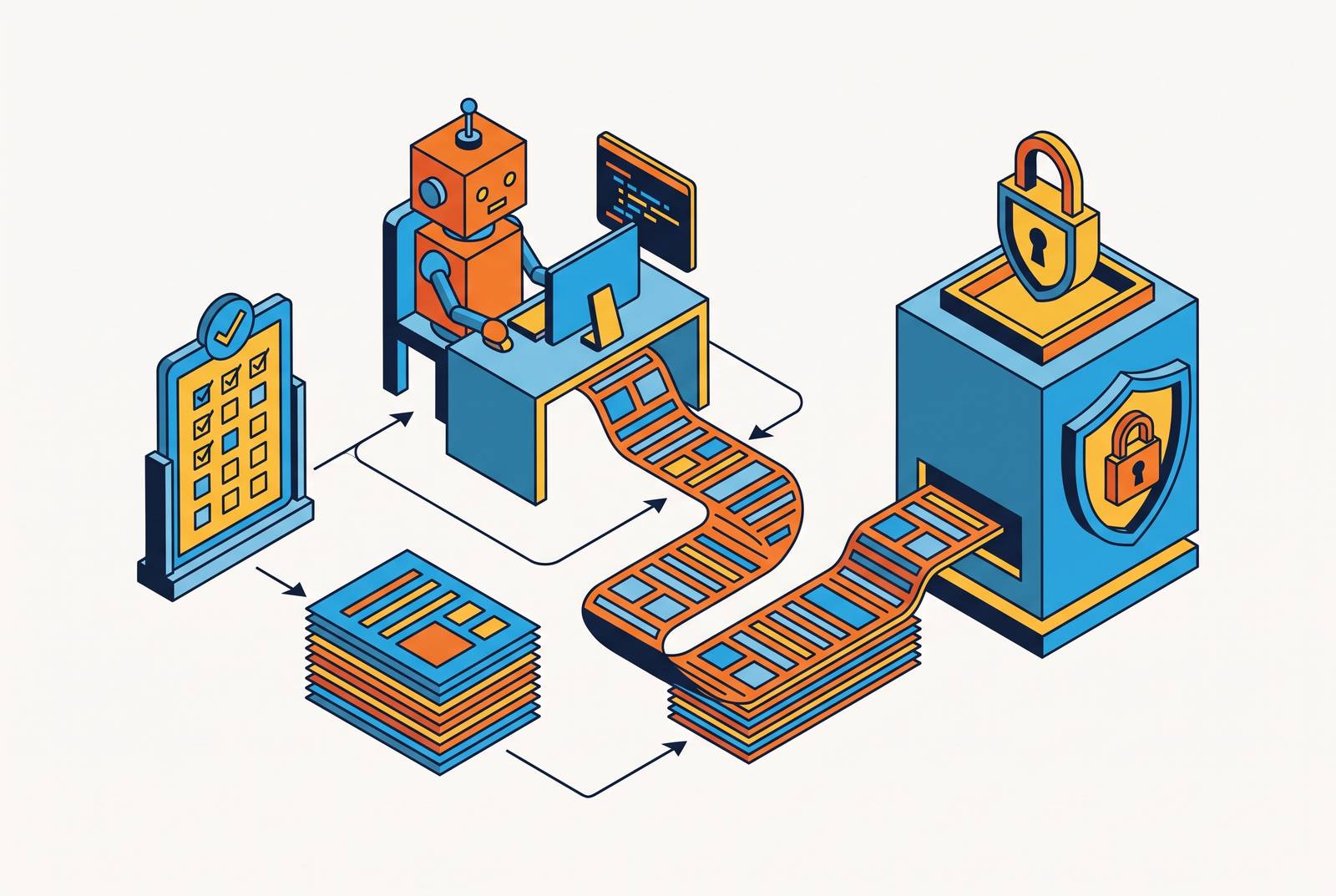
Auditors conducting SOC 2 examinations in 2026 have started asking a question that did not come up two years ago: who, or what, actually triggered this commit? That question marks a shift in how coding agents get classified. They are no longer filed under developer tooling and waved through as a convenience. Auditors now treat them as privileged identities, the same evidentiary category as a human service account with standing access to production systems. The Trust Services Criteria have not been rewritten to say this explicitly. As of October 2, 2026, the AICPA has not issued AI-specific criteria, and the 2017 Trust Services Criteria, with points of focus revised in 2022, remain the operative standard for every SOC 2 engagement. The real change is not in the framework's text but in what agents now do: an agent that can read a file, query a database, or hit a staging API has crossed from being a tool into being an actor, and an actor needs an account, a credential, a defined scope, and a log that survives scrutiny.
That reclassification touches every one of the five Trust Services Criteria at once, because each one assumes a system is doing something that needs to be governed. Security now depends on tight access controls for models and the APIs they call. If AI-dependent services are to stay up, they need the same consistency a human-run process would promise. Processing integrity requires validating what an automated system produced, not just what a person reviewed. Confidentiality also covers training data and model artifacts that sit alongside customer data. Privacy has to follow personal data through every stage of an AI workflow, not just the stages a person touched directly. None of these criteria were built with autonomous code-writing systems in mind, but none of them exempt one either.
The practical effect is that auditors now want auditable records of production execution itself, on top of the records they already asked for covering the decisions and automation workflows that led up to that execution. A log showing that a pull request was approved is no longer sufficient if nobody can show what the agent actually did once it had access. And the finding auditors report most often in 2026 is about AI employees are already using that the compliance team never approved, never scoped, and never logged. Coding agents make that problem worse, because they tend to get wired into terminals, IDEs, and CI pipelines by individual engineers long before anyone files a vendor review.
The three Trust Services Criteria that coding agents directly touch
Three specific criteria carry most of the weight when an auditor evaluates a coding agent, and each one demands something concrete rather than a general assurance that the system is secure.
CC6.1, logical access, is the one that catches teams off guard most often. The control depends on clear ownership of every privileged action, and a log entry that names only a tool, such as "CI/CD Runner," or points to a shared service account, will not satisfy it. Auditors will ask whether the agent has a named identity, a scoped credential, and a log entry tied to each action it takes, not just a record that something ran. A coding agent connected to a production read replica through MCP is a service account holding engineering-level access, often without multi-factor authentication, and CC6.1 requires it to be governed exactly as such an account would be.
CC8.1, change management, governs how code gets approved and shipped. Auditors ask for change approvals, access records, and architecture and data-flow diagrams whenever AI produces a customer-facing change or touches production code. A named reviewer, someone other than the change's author, has to be required in the pull request template and enforced through branch protection rules, combined with testing gates and documented authorization. Tagging a commit as AI-assisted in the trailer does not, by itself, meet this requirement. An auto-merge bot that approves its own AI-generated suggestions fails the control outright, because it collapses the separation between author and reviewer that CC8.1 exists to enforce. Auditors have also started extending change management testing to the models themselves: every model version running in production needs a documented approval chain, a record of the inputs that produced it, and a rollback procedure that has actually been tested, which maps directly onto CC8.
CC7.2 and CC7.3, covering monitoring and anomaly detection, address what happens once code is running. Processing integrity needs proof that automated code promotions and deployments did not skip validation steps, because a pipeline can push a change through without any person touching it. Auto-scaling infrastructure and short-lived agent sessions create a specific problem here: instances that spin up and disappear without consistent instrumentation leave holes in the log chain, and those holes are exactly where an auditor's confidence in monitoring coverage breaks down.
What the AICPA's newest guidance requires teams to scope
The most current nonauthoritative guidance on this subject is TQA Section 9561, listed September 11, 2026, addressing how a service organization's use of AI affects SOC 1 and SOC 2 examinations. It reaches further than guidance aimed at companies that train their own models. It speaks to any organization whose AI use touches the system under examination, so any company running coding agents against source code or production infrastructure falls under it. The guidance does not replace the Trust Services Criteria, and it carries no authoritative weight of its own, but auditors are using it right now to frame what evidence they request in active engagements.
The guidance sets a specific test for scope: AI use matters to a SOC 2 examination when it affects the system being examined, the service commitments made to customers, the system requirements, or the controls already in place. Running an AI experiment in an internal sandbox does not automatically pull that experiment into scope. If a coding agent touches source code, holds credentials, or reaches production infrastructure, it almost certainly does. That distinction forces a decision rather than a default: teams have to build an honest inventory of where AI sits in the product, in the development toolchain, in support functions, and in the operation of controls themselves, and assess each use for its connection to the examined system.
Where a use is clearly relevant, or even just uncertain, it requires a documented risk assessment and a scope agreed with the auditor in advance. Where no relevant connection exists, the right move is to document the reasoning for leaving it out and revisit that decision if the data or access involved changes later. A concrete version of this plays out whenever developers use an AI coding assistant: auditors test the approved-tool settings that govern which assistants are even allowed, the rules governing what data the assistant can see, the code review process applied to its output, the security testing run against that output, and the release records tying it all together. That five-part package is what auditors expect to see, not a policy document asserting that AI use is "responsible."
Fields an audit-ready log entry for a coding agent action must capture
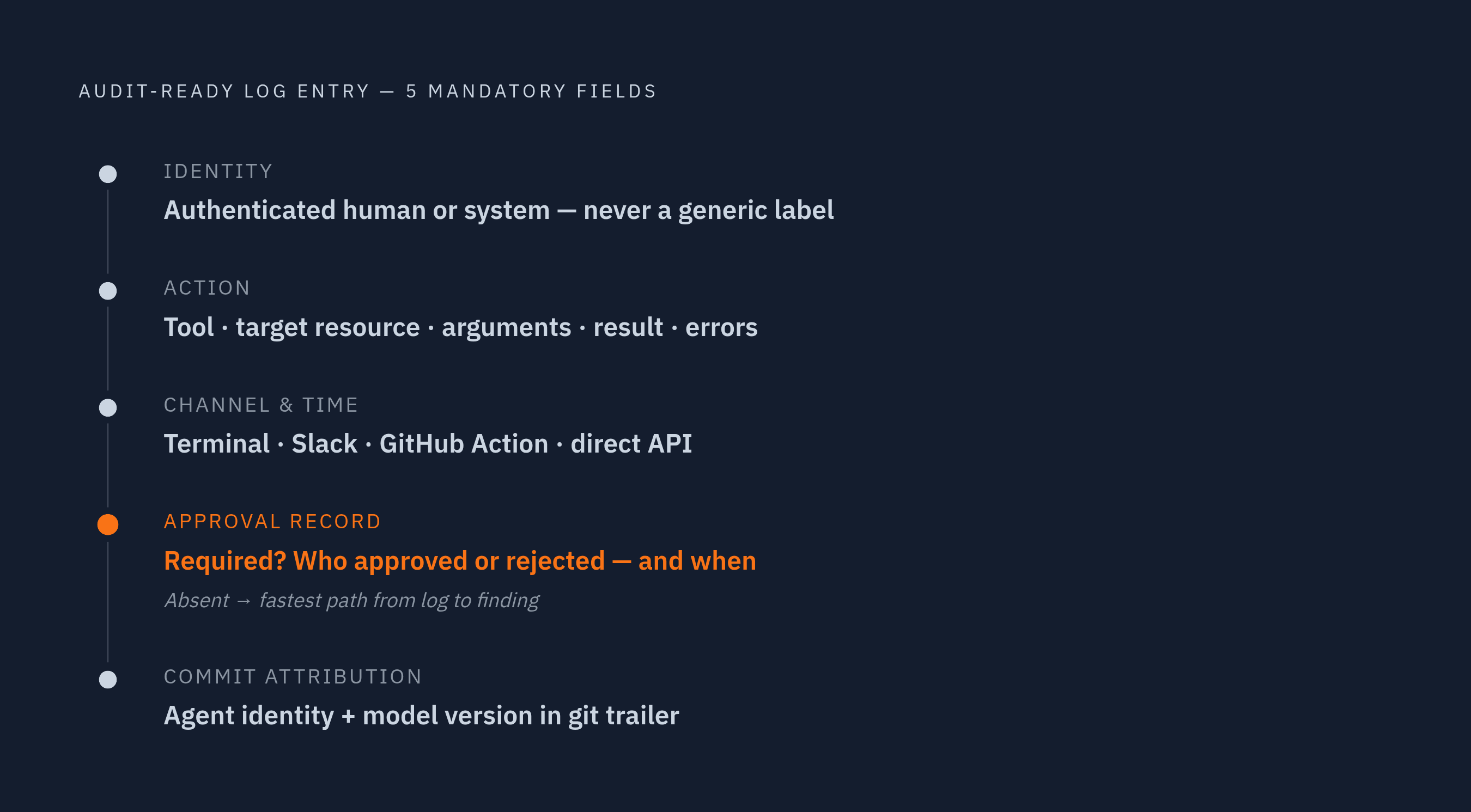
The compliance requirement here is traceability. An auditor needs to reconstruct why an agent took a specific action, what data it touched, and what governance policy applied to it at the moment it ran. So that standard turns into a specific set of fields every log entry needs to carry.
The entry needs to record who triggered the run: the authenticated human user or system identity behind the action, not a generic label like "the agent." A log that resolves only to a tool name or a shared service account gives an auditor nothing to question, which is itself the problem, because the auditor will ask who initiated and approved the action and find no answer.
The entry needs to record what the agent did: the specific tool or integration it called, the target record or resource, the arguments passed, the result returned, and any error raised along the way.
The entry needs to record when the action happened and through which channel, whether that is a terminal session, a Slack command, a GitHub action, or a direct API call.
The entry needs to record whether an approval was required for the action, who approved or rejected it, and when that decision was made. This field is what satisfies the segregation-of-duties requirement under CC8.1, and its absence is one of the fastest ways a log turns into a finding.
Commit attribution follows the same logic into version control. Every AI-generated code change needs to be tracked through the git commit history with full attribution to the specific agent and the work item that prompted it. Mandatory security review gates need to sit before production, so that AI-generated code cannot reach customers without a human verifying and signing off on it. The commit trailer, tagging the agent's identity and the model version it ran, is what an audit query searches for directly; without that trailer, sampling a set of commits for review turns into guesswork.
Two qualities separate a usable log from one that will draw questions. Completeness means the agent leaves no silent path where it can act without a record, and that gets harder to guarantee once auto-scaling creates short-lived instances that are not consistently instrumented. Tamper resistance means the log lives in append-only, immutable storage, so an entry cannot be edited or deleted after an action has already happened. Organizations should run a centralized logging repository with immutable storage and keep every log source synchronized against one trusted time standard, since logs that disagree on timing undermine the sequence an auditor is trying to confirm. The EU AI Act's Article 12 record-keeping requirements run on a parallel logic: systems need to generate logs automatically over their lifetime, which is the same operational discipline SOC 2 evidence now demands, arrived at from a different regulatory direction.
The three logging gaps that appear most often in audit fieldwork
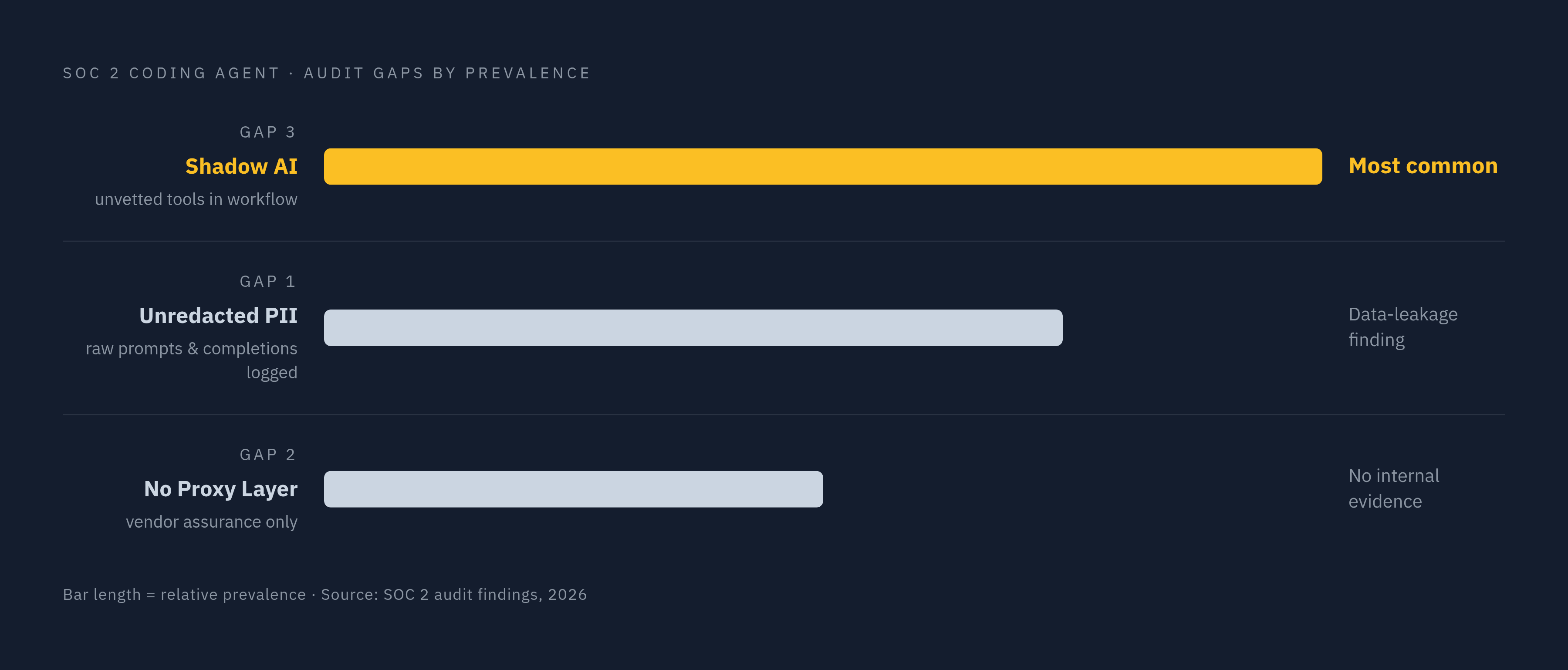
Three gaps account for most of the findings auditors write up around coding agents, and each one turns a logging control that looked fine on paper into a specific, named problem in the report.
The first gap is customer PII sitting inside raw prompts and completions. Startups commonly log everything an agent sends and receives without any redaction policy applied first, and those logs end up holding customer PII or protected health information. What started as evidence supporting an audit trail becomes evidence of a data-leakage problem instead. The approach that has taken hold in 2026 SOC 2 audits applies redaction before the log is written: customer data gets scrubbed out of the prompt before it is ever stored.
The second gap is the absence of a proxy layer standing between coding agents and the LLM providers they call. Without that layer, an organization has nothing but the provider's own assurance that data was not retained or that nothing leaked in transit, and auditors will not accept a vendor's word in place of internal evidence. Every prompt and every completion needs to pass through a gateway the organization itself controls, whether that takes the shape of a full AI gateway acting as a reverse proxy for every developer and every provider, or something closer to a thin wrapper around the API calls. The requirement is ownership of the log, not the sophistication of the tool producing it. LLM API keys need the same treatment as database credentials: stored in a secrets manager, rotated on a documented schedule, and revoked the moment someone leaves the company. Teams that treat an LLM API key as a convenience configuration value, dropped into an environment file and left alone, are the ones showing up with observations in their SOC 2 reports.
The third gap is shadow AI: tools that entered the development workflow without ever going through vendor management. This is the single most common AI-related finding in SOC 2 audits in 2026: not the AI a company chose to deploy, but the AI employees are already running without the compliance team's knowledge. For every LLM provider in scope, auditors now ask for four things: a signed or contractually incorporated Data Processing Agreement, written confirmation that customer data is not used to train the provider's models, a copy of the provider's own SOC 2 report or ISO 27001 certificate, and a documented vendor risk assessment. The scoping inventory required under TQA 9561 is meant to catch exactly these tools before an auditor finds them independently, but it only does so if the organization applies that inventory to the development toolchain with the same honesty applied to the product itself.
Credential scoping and sandbox isolation as logging prerequisites
A complete log cannot be built on top of an agent running with shared, long-lived credentials inside a shared environment. The logging architecture and the infrastructure it describes have to be designed together, because a log can only attribute an action as precisely as the credential behind that action allows.
Session-scoped credentials are the foundation that attribution depends on. Each agent session needs a credential minted fresh for that session and revoked the moment the session ends. A shared service account that persists across sessions makes it impossible to trace a given tool call back to the specific trigger or human identity that set it off, no matter how detailed the rest of the log is. Security evidence depends on clear ownership, and a log that resolves only to a tool name or a shared account will not survive scrutiny under CC6.1, regardless of how many other fields it carries.
This same pattern satisfies the least-privilege expectation built into CC6.1. A credential scoped tightly to one session cannot accumulate permissions as it moves from one task to the next, which closes off the slow privilege creep that shared, persistent accounts tend to produce over time. Credential scoping and audit logging are the same requirement, approached from two directions: one defines what the agent is allowed to touch, and the other proves what it actually did.
Sources
- SOC 2 for AI Companies (2026): What Auditors Test First
- SOC 2 and AI in 2026: The Criteria Didn't Change, but the Examination Did - Weinlander Fitzhugh
- AI and the SOC 2 Internal Controls Framework - Arizona Society of CPAs
- AI Agent Audit Log Requirements: ISO 42001 & SOC 2
- The SOC 2 AI Gap: Auditors Improvise Where AICPA Has Not Acted