CI Pipeline Integration for Agents That Auto-Triage Build Failures
Security and credentials matter more than the agent logic itself.
Build-failure triage is turning into agent territory; the mechanical part of that shift is already done. What's hard is the layer around it: the credentials the agent holds, the box it runs the fix in, and the record it leaves behind once the session ends.
The pressure to push AI further down the pipeline is real and it appears in adoption numbers 2025 Stack Overflow Developer Survey Elastic. The Stack Overflow Developer Survey found 84% of developers already using AI in their workflow or planning to, and that kind of penetration doesn't stay at the editor level 2025 Stack Overflow Developer Survey Elastic. Once a team trusts a model to write code, the next question is obvious: why not let it read the failure log too, and take the first pass at fixing it, before anyone's paged 2025 Stack Overflow Developer Survey Elastic? The shift underway looks less like an incremental feature and more like a phase change: teams have moved from completion to delegation, handing agents issues, tests, migrations, refactors, and cleanup, and from isolated tools to workflow entry points across IDEs, CLIs, GitHub issues, Slack, and cloud environments. The pressure on pipelines specifically is measurable, too. The Harness State of DevOps Modernization 2026 report found that 45% of developers who use AI coding tools multiple times a day deploy to production daily or faster, against 15% of weekly users, and that velocity gap is exactly why existing triage processes are straining.
This piece is about what has to be true structurally before you let an agent run without a person watching it, especially overnight. It's about what has to be true structurally before you let one run without a person watching it, especially overnight. Engineering teams are wiring agents into CI/CD pipelines right now, and the discussion avoids general AI hype, consumer AI tools, and anything unrelated to engineering pipelines.
What a build-failure triage agent does during a session
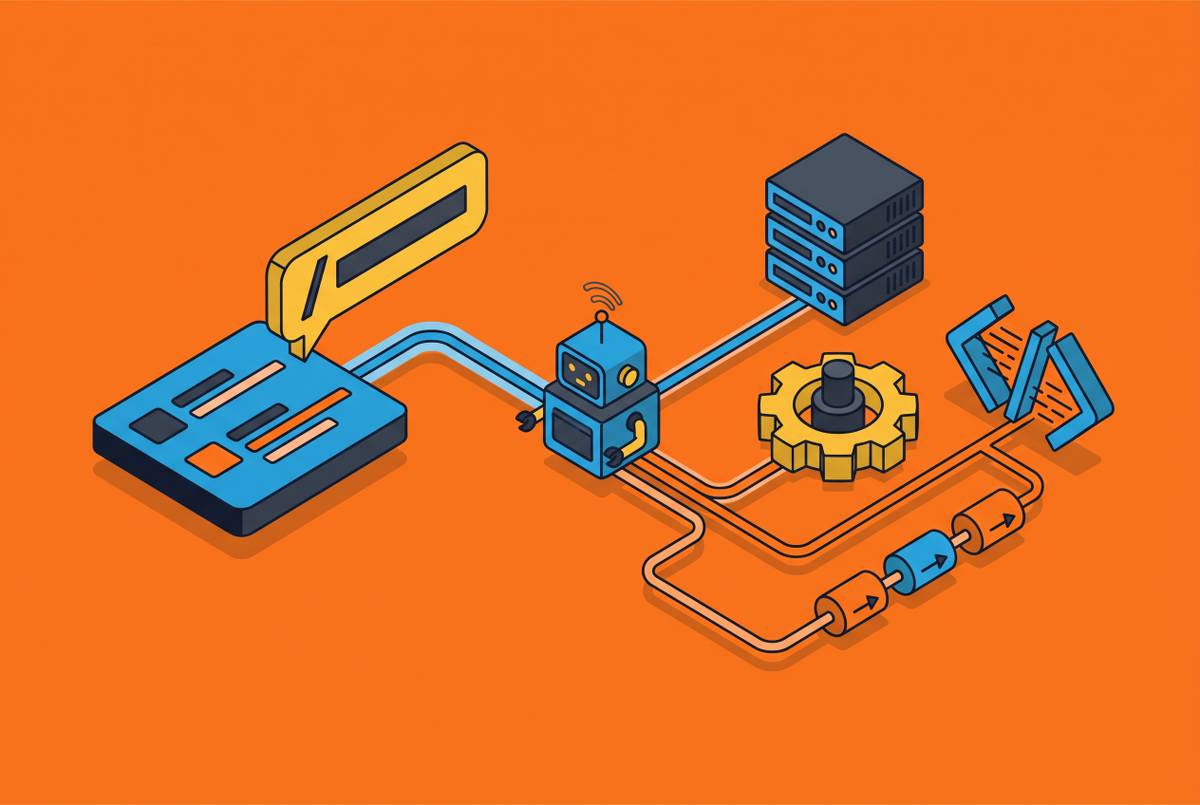
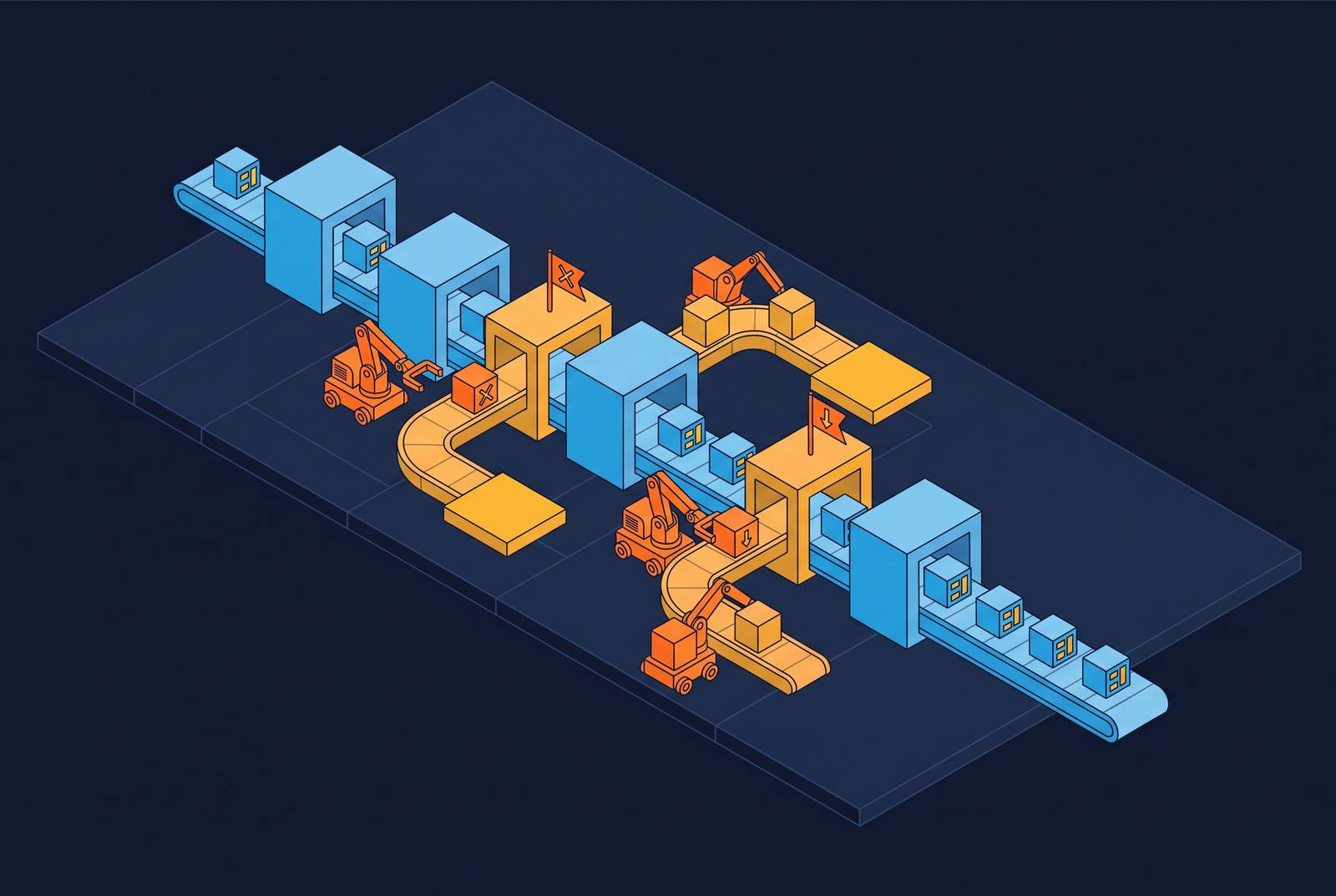
The loop is straightforward to describe. CI throws a failure, a webhook listener catches the signal, the agent gets handed structured context (the stderr block, the file that failed, the recent git diff), it reasons about the cause, generates a patch, verifies that patch in a throwaway sandbox, and opens a PR on a temp branch. Six steps, no magic. Under the hood, that loop typically runs on three components: a webhook listener tied to the CI provider, an agentic framework handling the reasoning loop, and an ephemeral sandbox for safely testing whatever fix gets generated https://dev.to/pratik_12b3f8bf3b50e48bae/how-to-build-a-self-healing-cicd-pipeline-with-ai-agents-2026-guide-g00.
Teams get wrong early what they feed the model. Logs that long get truncated before they reach the model's context window, and that truncation causes hallucination. The agent needs the fatal error block and the lines around it.
The Log Doctor, sometimes called the Pipeline Doctor or Interceptor pattern, names this approach directly. A specialized agent parses the stderr, classifies the failure (missing dependency, broken config, whatever it is), checks the relevant config file, applies a fix, and kicks off a rebuild, all without paging a human for something that was always recoverable.
None of this happens in one shot. The agent analyzes, patches, reruns tests, and if the tests still fail, it goes again. Production setups cap that at three iterations before the agent hands the problem to a person, which matters both for correctness and, as covered further down, for cost.
Research out of the University of Toronto and Trent University draws a boundary: triage agents belong on the data plane, meaning patch generation and test reruns, not the control plane, meaning pipeline config, deployment policy, or approval gate settings. The paper itself, authored by Barnes and Hassan at Toronto alongside Ghaleb at Trent, frames the split precisely as one between "data-plane authority (localized interventions such as patch generation and test reruns)" and "control-plane authority (modifications to pipeline configuration, deployment policies, and approval gates)" https://arxiv.org/html/2605.07062. Every incident that starts with "the agent shouldn't have been able to do that" traces back to this line getting blurred.
What the agent actually touches in one session is short and countable: the log, a handful of files, a git diff, a scratch branch. That narrowness is exactly why the problem of credentials being overexposed below is solvable.
Escalation isn't a failure state, it's the design working as intended. An agent that hits its iteration cap without a fix should hand off cleanly to a person rather than looping forever or quietly dropping the failure on the floor.
Scoped credentials as the first deployment priority
Broad credentials are what turn a fixable configuration mistake into a supply chain incident. The agent doesn't need to be malicious for that to happen, it just needs more reach than the task called for.
Traditional service-account thinking doesn't hold up here.
The fix is to mint credentials fresh for each triage session, scope them to exactly what that session needs, read the log, read the file, push to one named scratch branch, open one PR, and revoke them the moment the session ends. No long-lived token sitting in an environment variable, waiting to be the thing an attacker or a bad prompt finds.
MCP complicates this if it's left ungoverned. It's becoming the standard way agents talk to tools, and it needs the same enforcement discipline teams already apply to API gateways. Every MCP request should pass through a checkpoint that can say no. An agent that can reach arbitrary tools over MCP without that checkpoint has, functionally, escaped whatever scope you thought you'd given it.
Before anyone writes a webhook handler, the useful exercise is to map every tool call the agent will ever make in a session and ask, for each one, whether the credential behind it can be narrowed to that call alone. If the answer is no, the scope is still too wide.
Sandboxed execution: why the agent's fix environment must be isolated from your real infrastructure
Verification is where the risk actually lives. Applying a patch is cheap, but running it to confirm the fix works means executing code, and executing code makes an agent a process with side effects.
A sandbox built for this needs a specific set of guarantees: no path to production credentials, no outbound network access beyond what verifying the fix requires, a filesystem that gets thrown away when the session ends, and resource limits so a runaway loop doesn't turn into a runaway bill. None of these are exotic asks. They're the same isolation properties any ephemeral CI runner already has, just applied one layer earlier.
Branch discipline matters just as much as the sandbox itself. The agent pushes to something like ai-fix/issue-123, never to main, never to a release branch. The deterministic CI pipeline then runs against that branch and returns a plain pass or fail, and that binary signal is what decides whether the fix moves forward at all.
The sandbox is the primary safety mechanism, not an optional feature bolted on for compliance. It's the primary safety mechanism, full stop.
There's a clean way to tell a prototype from something production-ready: an agent running in a laptop terminal or on a shared CI runner with no isolation is a demo. The same agent in a per-session ephemeral sandbox, with credentials scoped and expiring, is a system you can actually leave running.
Audit trails: what to log, why every tool call must be attributable
Agents don't behave like deterministic scripts, and that's the whole problem with skipping the audit layer. You need the prompt and the tool calls.
The minimum logging bar is fairly concrete: every tool call along with its inputs and outputs, every diff the agent staged, the model's reasoning trace if the provider exposes one, which credential backed each call, what triggered the session in the first place, and how it ended, PR opened, escalated, or abandoned. Skipping any one of those leaves a gap in the story the next time something goes wrong.
Format affects how quickly teams can trace history. A question like "which triage sessions touched this file in the last month" should return an answer in seconds, not require someone to reconstruct it by hand.
Attribution can't be negotiated away. Every action the agent takes has to trace back to a person or a defined trigger; "the agent did it" doesn't hold up when a regulator, an auditor, or an incident responder asks what changed and who's accountable for it. As Spacelift frames the distinction between agentic and traditional CI/CD, the core problem with unobserved agents is that two runs against the same commit can diverge, and when they do, you need to read the prompt and the tool calls, not just the log, since the log alone does not tell you why the agent did what it did.
Governing token spend and iteration limits before an agent runs unattended overnight
Cost behaves differently here than it does in a normal pipeline. CI compute minutes are predictable and roughly fixed; token spend swings with log length, how many iterations the agent takes, and which model's doing the reasoning, and a genuinely hard failure can spike that spend fast.
The iteration cap covered earlier isn't just about correctness, it's a budget mechanism too. An agent stuck looping on a hard architectural problem doesn't just waste the team's patience, it burns tokens on every single retry, and the common three-iteration limit works as an implicit spending ceiling as much as a quality one.
Enforcement needs to be applied at three separate levels: per session, so one triage run can't blow past its token budget, per developer or trigger, so a webhook misfiring on every commit can't drain a month's budget in a night, and per time period, with weekly or monthly caps that warn before they cut things off.
Monitoring after the fact tells a team what got spent. A hard cap enforced before the session even starts stops the spend from happening at all, and that distinction is the whole ballgame when the agent's running unsupervised at 2 a.m..
Putting the credential model and the budget model together produces something useful: a session-scoped credential that's also budget-bounded gives the team two separate kill switches, one for access, one for spend, and neither one depends on the other working correctly.
Where human approval gates belong in the triage workflow
The agent's role, in every case that touches production, is proposal, never final say. Spacelift frames it well: keep the agent in the proposal role and let deterministic checks verify what it produces. The agent opens the PR, the pipeline's own test run decides whether the fix actually works, and a person decides whether it merges.
Not every fix needs the same weight of review. Data-plane changes, patching a missing import, fixing a lint failure, adding a dependency that was left out, can move with minimal human oversight as long as the sandboxed verification passes, because the deterministic CI run on the fix branch is already functioning as the approval gate.
Control-plane changes belong to a different category. Anything that touches pipeline configuration, deployment policy, or the approval gates themselves needs a person to sign off regardless of how confident the agent seems, because the authority being handed over is a different kind of authority, and the blast radius if it goes wrong is a different order of magnitude.
Barnes and coauthors note that current industrial systems mostly keep agents confined to the data plane under bounded autonomy on purpose, and they call out control-plane safety as the most urgent unsolved problem in the research agenda. Teams that let agents touch pipeline config directly are, in a real sense, ahead of what the safety research has actually settled.
Escalation, when it happens, should leave something useful behind rather than a dead end. A structured summary of what the agent tried, what the error looked like at each attempt, and a recommended next step gives the human picking it up a running start instead of a cold trail.
How managed cloud platforms handle the governance layer
Building all of this in-house, scoped credentials, sandbox isolation, structured audit logs, budget enforcement, is a real engineering project on its own, and platforms are starting to absorb pieces of it directly.
JetBrains has gone this route with TeamCity, pairing it with MCP through Context7 so agents can configure build configurations, full build chains, and build parameters by working against structured documentation rather than guessing. JetBrains itself explains the mechanism plainly: "This works because TeamCity documentation is structured and accessible through MCP via Context7, and because agents can rely on tools like the TeamCity CLI and the teamcity-cli skill" https://blog.jetbrains.com/teamcity/2026/06/teamcity-aws-ami-builder/. Worth noting is that TeamCity's own built-in MCP integration, as of the 2026.1 release, is scoped more narrowly than that, focused on build logs and failure analysis rather than configuration changes https://blog.jetbrains.com/teamcity/2026/06/teamcity-aws-ami-builder/. Governance in that setup isn't bolted on separately, it's inherited from the role model TeamCity already had in place.
There's also a category of managed cloud platform built specifically to run coding agents like Claude Code with governance treated as a core requirement rather than an afterthought. Agents get defined as YAML configuration checked straight into the repo, each session runs in its own isolated sandbox, credentials get minted fresh per session and revoked the moment it's done, and every tool call and diff gets logged in a way that's attributable back to its trigger.
The pattern across both is the same: the governance layer that this piece has spent most of its length describing, scoped access, sandboxing, audit trails, budget limits, isn't something every engineering team needs to invent from scratch anymore. Whether a team builds it in-house or leans on a platform that's already done the work, the requirements themselves don't change. Skipping any one of them turns what looked like a solved mechanical problem back into a governance problem nobody wanted to own.