REST API Design for Programmatic Agent Dispatch
Design REST APIs for machine clients, not humans: prioritize idempotency and structured errors.

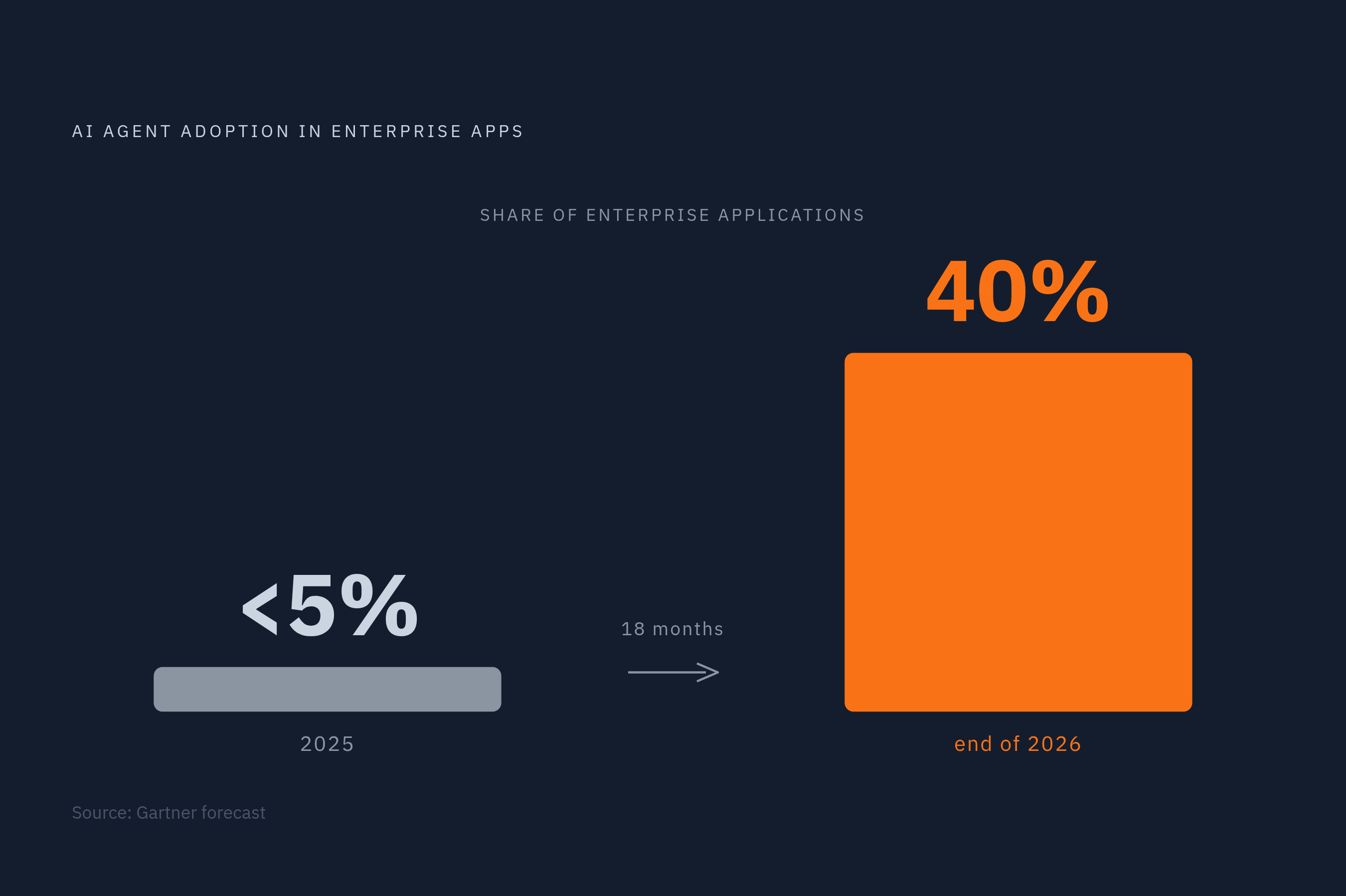
When an AI coding agent is the API consumer, dispatched programmatically to review PRs, triage incidents, or run migrations, the design decisions that matter most shift from human-readability toward machine-parseability, idempotency, structured error contracts, and credential scoping that fits ephemeral session lifecycles. A McKinsey survey found that engineers spend roughly 40% of their time on work adjacent to actual development, including PR review, bug triage, CI/CD wait times, and documentation. That's exactly the outer-loop work agents are now picking up. Gartner's forecast puts task-specific AI agents in 40% of enterprise applications by the end of 2026, up from under 5% in 2025 McKinsey. The traffic composition of APIs is already shifting McKinsey.
Human callers tolerate ambiguity. Agents don't do any of that. An agent retries aggressively on failure, parses errors as structured data rather than prose, operates at a request cadence no human could sustain, holds zero conversational memory between calls, and never opens your Confluence page to figure out what went wrong. It means an API built with the usual human-first assumptions, forgiving of vague 200-with-error-in-body responses, tolerant of undocumented retry semantics, will fail in ways that compound instead of degrading gracefully.
This piece is not a general REST primer. It's a working discipline for the dispatch layer specifically, the contract that lets engineering teams put agents to work on production systems and trust the result. Everything from here forward assumes that lens. The API caller has changed: agents dispatched to review PRs, triage incidents, run migrations, or orchestrate deployments are the growing consumer class.
Where REST succeeds and fails for agent dispatch
REST earns its keep in agent architectures for reasons that predate agents. It's stateless per request, which maps cleanly onto how an agent session actually behaves: spin up, execute a bounded task, tear down, with no assumption of shared memory between calls. The verb semantics are predictable and HTTP-native, POST creates, GET retrieves, DELETE removes, which makes the audit trail legible without extra tooling. The gateway ecosystem around REST, rate limiting, authentication enforcement, observability, is mature and already deployed at most shops. Postman's State of the API Report still finds REST the dominant architectural style across industries, and that dominance isn't accidental. For agents dispatched to a fixed set of known operations, REST's explicit and unchanging interface is an asset, not a limitation: the contract doesn't shift under the agent's feet between calls.
The gap appears at the edge of that boundary. REST has no runtime self-description. An agent can't interrogate a REST endpoint and ask what it does, what it expects, or what it returns on failure; a developer has to hardcode that knowledge into the dispatch system ahead of time. For bounded, known tasks, that's a one-time cost, tolerable and even preferable, since it forces the kind of explicit contract design this article argues for. But it becomes a real bottleneck the moment agents need to discover and select among many capabilities across systems they weren't specifically wired up for in advance.
That gap is exactly where the architectural fork sits. When the dispatch layer is predefined and governed, meaning someone has already decided which operations an agent may call and under what conditions, REST is the right execution surface. When agents need dynamic, runtime discovery of tools across systems nobody pre-wired, something has to sit in front of REST to handle that discovery, and that's the role MCP plays. The working model for the rest of this piece treats REST as the execution layer for governed, predefined agent operations, the actual dispatch contract that production teams enforce day to day.
REST vs. MCP: where each belongs in an agent dispatch architecture
MCP and REST solve different problems, and treating them as competitors misreads what each one is for. MCP standardizes how an agent discovers and invokes tools at runtime, through machine-readable schemas and natural-language descriptions it can parse before ever making a call. REST executes the underlying business operation, the actual read, the actual write, the actual pipeline trigger, under a contract that's stable and auditable long after the agent session has ended. One handles the question of what's available and how to call it; the other handles the question of what actually happens when you do.
The July 28, 2026 MCP specification update closed several of the objections that had followed the protocol since its early releases. It introduced a stateless core, cacheable list results for tool and resource lookups, gateway-friendly headers, and tighter OAuth issuer validation, addressing the earlier complaint that MCP was too stateful to run safely in production. The new spec requires implementation support, and some SDK configurations still use earlier protocol behavior, so version negotiation needs to be verified before anyone designs infrastructure around stateless operation. Adoption numbers back up that MCP is past the experimental phase: Gartner forecasts that 75% of API gateways will support MCP by the end of 2026, and the protocol has already logged over 97 million SDK downloads with more than 13,000 MCP servers listed on GitHub KPMG REST API for AI Models Explained: 2026 Guide | MLflow.
None of that displaces REST underneath. The practical pattern that's emerged is a thin MCP server wrapping existing REST endpoints, adding tool schemas and natural-language descriptions on top, with the underlying REST API unchanged (MCP is a translation layer, not a replacement). The decision rule that's held up in practice comes from the Quokka Labs architecture matrix (dev.to, 2026-09-22). For the dispatch layer this article is concerned with, agents assigned to bounded tasks like reviewing a PR or triaging an incident, REST executing known operations is the correct surface. The engineering work that actually matters is making sure those REST endpoints hold up under agent traffic.
Idempotency as a first-class design requirement for agent-facing endpoints
Idempotency is essential for agent-facing endpoints. A system that degrades safely differs from one that silently corrupts itself. Agents retry on network failures, on timeouts, on ambiguous 5xx responses where it's genuinely unclear whether the original request landed, and without idempotency built in, a single failed POST can trigger a duplicate database write, a duplicate charge, or a duplicate model invocation that nobody notices until the bill or the diff looks wrong.
The HTTP spec already gives you half the answer. GET, PUT, and DELETE are idempotent by definition, repeated calls land on the same state regardless of how many times they fire. POST and PATCH are not, and they won't become safe to retry just by wishing it so; they require deliberate design. The standard pattern is an idempotency key passed in a request header, stored server-side with a short TTL. If a duplicate key shows up inside that TTL window, the server returns the cached response instead of re-executing the operation. For agent traffic specifically, that key needs to be scoped to the operation rather than just the session, since agents frequently run parallel sub-tasks that can hit the same endpoint concurrently. The TTL itself needs to outlive the agent's maximum retry window, which on a flaky connection can stretch to several minutes, and on a genuine failure with no cached response to return, the error itself should echo the same idempotency key back so the agent knows it's safe to retry rather than guessing.
There's a useful way to think about why this matters beyond the obvious duplicate-write problem. The Agent-Diff benchmark, published in February 2026, evaluates agent task success by comparing the expected change in environment state against what actually happened, a state-diff comparison rather than a judgment about whether the agent's reasoning looked sound. Idempotency is precisely what that evaluation method depends on. A duplicate side effect corrupts the state diff and fails the task even when the agent's intent, and its actual decision-making, was entirely correct. The endpoint's design decides whether a correct agent looks correct in the record.
Every POST and PATCH endpoint in the OpenAPI spec should carry an explicit label describing its idempotency behavior and key format. An agent consuming that spec at dispatch time needs that information up front, not discovered the hard way after a retry duplicates a merge.
Structured error contracts that agents can act on without human interpretation
Agents don't read error messages the way people do. An agent parses a response structurally, checking the status code and the shape of the body, and a 200 OK with {"error": "not found"} buried in the payload is functionally invisible to any agent checking only whether the call succeeded. That single design mistake, returning a success code with failure semantics inside, breaks retry logic more thoroughly than almost anything else on this list.
A workable error envelope needs at least: a machine-readable error code as a string, something like RATE_LIMIT_EXCEEDED or IDEMPOTENCY_KEY_CONFLICT, distinct from the raw HTTP status; and a trace or correlation ID the agent can log and surface in its own audit trail.
Status code discipline matters just as much as the envelope shape. A 429 should carry an optional Retry-After header, and agents should check for it and honor it, falling back to exponential backoff only when it's absent. A 503 signals transient backend overload and should trigger the same exponential backoff pattern. Agents need to know whether to re-authenticate (401) or escalate a permissions failure (403); conflating them wastes retries and obscures credential issues.
Two extensions matter specifically for agent traffic. Batch operations, the kind of bulk PR review or migration task agents are often dispatched to run, should return a structured per-item result array on partial failure rather than a single top-level error. Every error code should be documented in the OpenAPI spec with enough precision that an agent can map it directly to a retry policy or an escalation path without a human stepping in to interpret it. 400 Bad Request vs. 422 Unprocessable Entity: agents distinguish malformed syntax (400) from semantically invalid input (422); conflating them breaks retry logic. Include the idempotency key in conflict errors (409) so agents know which operation collided.
Rate limiting and pagination designed for machine-speed agent traffic
Rate limits designed around human traffic patterns don't hold up against agent traffic, and the failure runs in both directions: limits set for browser or mobile clients either block legitimate agent workflows outright or fail to contain a runaway loop before it does real damage.
The fix starts with separating rate limit tiers for agent clients, using a dedicated API key type or a client-type header to distinguish that traffic from human traffic. Limits should apply per session, not just per user, since an agent session dispatched to review a single PR ought to have its own budget ceiling, distinct from the developer's personal quota. Response headers should expose the limit state directly, X-RateLimit-Remaining and X-RateLimit-Reset, so an agent can self-throttle before it ever hits a 429 rather than discovering the ceiling by crashing into it. And when an agent does exhaust its session limit, the right response is a hard, terminal error with a clear escalation path that tells the agent its request registered.
Pagination needs the same machine-speed thinking. Total counts or has_next_page indicators let an agent plan out its remaining work budget instead of paging forward blind and burning calls it didn't need to spend. These limits are the external enforcement surface for the internal budget caps that govern how much an agent is allowed to spend in tokens or compute, and they should complement those internal caps rather than duplicate a different version of the same rule.
Credential scoping and token lifecycle for ephemeral agent sessions
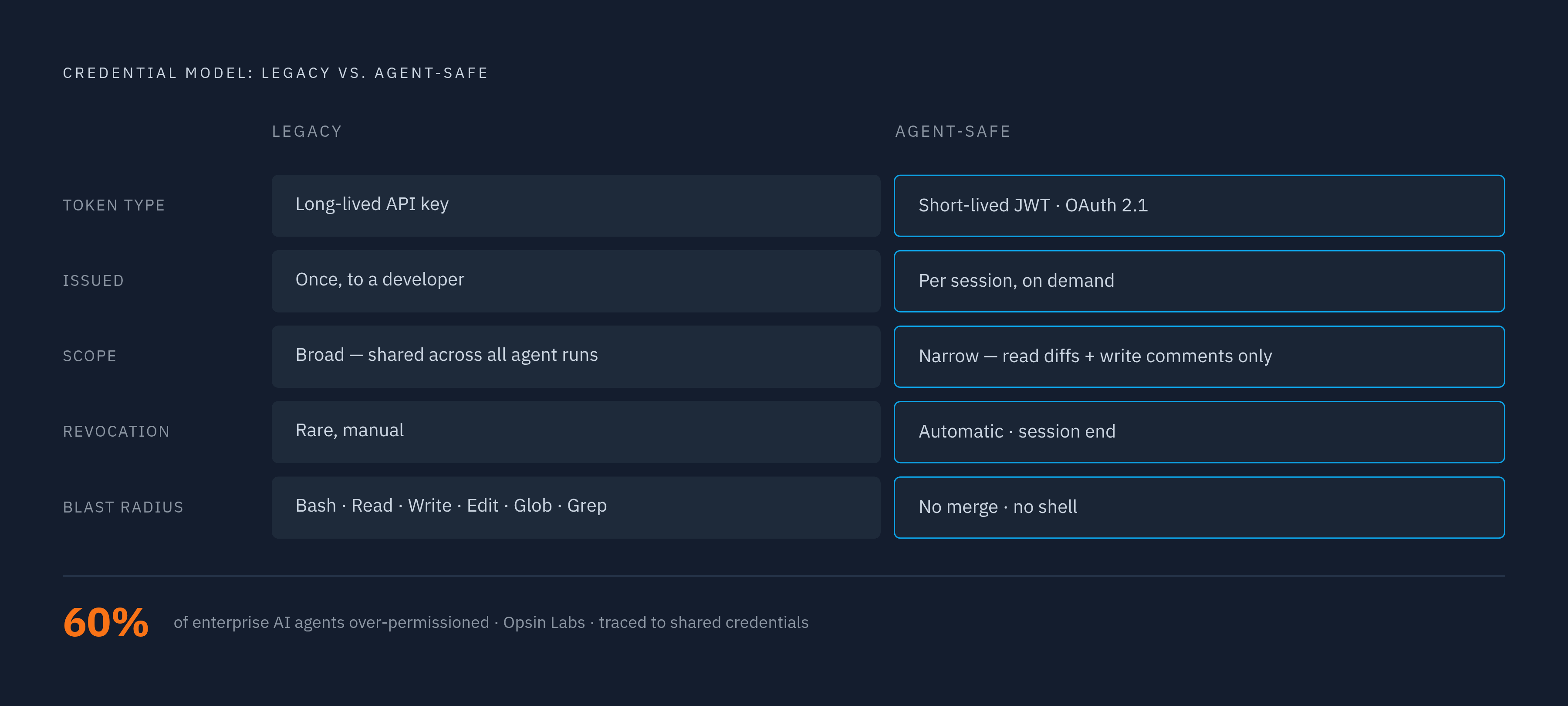
Traditional API key issuance was built around a person, one key, issued once, used for months, revoked rarely if ever. That model breaks down immediately once the caller is an agent session that exists for minutes. A long-lived API key issued to a developer and then shared across dozens of agent runs violates least-privilege on its face, and revoking it cleanly, without breaking every other session still using it, is close to impractical. An Opsin Labs report found that 60% of enterprise AI agents were over-permissioned, and traced the primary cause to exactly this pattern: credentials shared across sessions instead of minted fresh for each one.
The better model mints a short-lived token per session, scoped narrowly to whatever that specific session actually needs, and revokes it the moment the session ends. OAuth 2.1 is the sensible baseline here, short-lived JWT tokens carrying explicit scopes. Scopes should map directly onto REST endpoint permissions: a PR-review agent gets read access to diffs and write access to review comments, and does not get merge permissions. Session identity should propagate through every downstream call the agent makes, so an audit log can trace any given action back to the exact dispatch event that triggered it, not just to a generic service account.
GitHub's Agent Tasks REST API, launched in May 2026 for Copilot Business and Enterprise and extended in June 2026 to Copilot Pro, Pro+, and Max, supports authentication with personal access tokens (classic and fine-grained) and OAuth tokens, and fine-grained PATs are the production pattern here: scope to the exact repositories and operations a session needs. Internal agent-to-service calls deserve mTLS on top of token scoping, since that layer encrypts the channel and validates the identity of the service itself, not just the human or agent behind the request, which matters most for internal APIs that were never meant to be exposed publicly.
The consequences of skipping this are not theoretical. Between December 2025 and February 2026, an agent deployment running with an overly permissive configuration, allowed_non_write_users: "*", let any GitHub user trigger an agent carrying Bash, Read, Write, Edit, Glob, and Grep access on Actions runners. On February 17, an unknown actor used a previously stolen npm token, one that had been improperly rotated, to publish an unauthorized package that stayed live for eight hours before it was pulled. The root cause wasn't a model failure or a reasoning error. It was credential over-permissioning, plain and simple, the exact failure mode narrow scoping is built to prevent.
The design implications for REST endpoints follow directly. Sensitive operations, merges, deploys, deletes, should require a distinct, narrower scope beyond just holding a valid token, and that scope needs to be validated server-side on every single call, not checked once at session creation and then trusted for the rest of the session's lifetime. And the dispatch layer should expose a revocation endpoint that an agent or its orchestrator can call the moment a session ends, closing the credential window rather than letting it expire on its own schedule.
OpenAPI spec design as the machine-readable contract agents operate from
OpenAPI has been the de facto standard for REST documentation for years, but its job changes once the primary reader is a dispatch system instead of a developer skimming for the right endpoint. For an agent, the spec isn't reference material, it's the operational input the dispatch layer uses to figure out what operations exist, what parameters they require, and what shape the response takes before it ever makes the call.
That shift calls for a handful of additions most human-oriented specs never bothered with. Every endpoint that takes an idempotency key needs that field documented alongside its TTL and its conflict behavior. Rate limit tiers should be labeled per endpoint, agent tier versus human tier, so the dispatch layer knows which budget it's drawing against. Scope requirements should be listed explicitly per endpoint, so the system minting credentials for a session requests exactly the right scope up front instead of guessing conservatively wide or dangerously narrow. Error codes belong in the response schema as enumerated values, not folded into a paragraph of prose a human might read but no parser will. And operation descriptions themselves should be written for an LLM to parse rather than a person to scan, meaning concrete and structured, free of marketing language.
None of that works if the spec isn't reachable at runtime. Serving it at a predictable, fetchable location, /openapi.json, lets agents and MCP wrapper layers pull it programmatically rather than depending on a developer to have manually configured the dispatch system ahead of time. That single design choice, treating the spec as a live, queryable contract instead of a static document handed off once during onboarding, is what actually lets the rest of this architecture, idempotency, structured errors, scoped credentials, hold together as a system agents can operate against reliably.
Sources
- REST API for AI Models Explained: 2026 Guide | MLflow
- MCP vs REST API for AI Agents: Production Decision Matrix (2026) - DEV Community
- Agent-Diff: Benchmarking LLM Agents on Enterprise API Tasks via Code Execution with State-Diff-Based Evaluation
- A Case-Bundle Operating Model for Coding Agents in OpenFOAM-Based CFD
- The 2026-07-28 Specification | Model Context Protocol Blog