Role-Based Access Control Implementation for Coding Agent Fleets
Treating agents as named identities with scoped tokens enables provable access control.

Role-based access control implementation for coding agent fleets starts with treating agents as first-class identities. Scoped session tokens, version-controlled roles, and attributable tool-call logs turn that commitment into enforceable governance. Without all three, a fleet’s permissions remain broader than its tasks and harder to prove than its policies suggest.
Why agent fleets cannot inherit human RBAC patterns unchanged
Human access usually changes when someone is hired, promoted, or let go, and the organization can trace that change. An agent’s effective access can change when someone edits a prompt, registers a tool, or updates a configuration file. None of those changes necessarily triggers the workflow that governs a human’s permissions. After these changes, the same agent identifier can have different capabilities from one run to the next, so a stable role no longer guarantees a stable identity behind it.
Shared service accounts conceal that mismatch. Gravitee’s 2026 State of AI Agent Security report found that nearly half of organizations rely on shared API keys for agent-to-agent authentication. Agents also plan and chain legitimate tool calls in sequences that were not explicitly scripted. A firewall does not stop prompt injection, and an API gateway alone does not stop an over-permissioned agent from sending data through an otherwise permitted call.
What happened when teams skipped access controls: documented incidents, not hypotheticals
GTG-1002 used jailbroken or manipulated coding agents to execute the vast majority of an espionage operation against roughly 30 targets. Other documented incidents included a production database that was deleted in a single API call and a hijacked coding-assistant session that spread a supply-chain worm across roughly 100 internal repositories. With broad permissions, a compromised session had power over systems outside its task.
Configuration and command approval also proved vulnerable. ACRSTEALER rules in May 2026 took plaintext API keys from configuration files kept in places that were easy to predict. Adversa AI’s GuardFall research in June 2026 bypassed built-in command-approval guards in 10 of 11 popular open-source coding agents using older shell techniques. Auto-approve flags partially reopened the hole in the remaining agent, although the most destructive commands stayed hard-blocked. Access control must therefore precede deployment rather than depend on an agent’s own approval behavior.
Agents as first-class identities: the foundational design decision
The foundational commitment is to make each agent a named, bounded, attributable identity. Its minimum definition includes an identifier, its own credentials, an owning team, and a policy. A token borrowed from a human or a fleet-wide key cannot show which agent was responsible. Without a distinct principal, an access review cannot reliably establish who did what.
Separate identities make it possible to grant or revoke one agent’s access without disturbing the rest of the fleet. They also support different policies for support, analytics, engineering, and automation agents. Each action can then be attributed to the agent and the trigger that started its work.
Designing the role model: what principals, roles, and scopes look like for a coding agent fleet
The role model needs four levels of specificity, namely organization, workspace, agent class, and individual action. Organization policy determines which agent classes, models, and tool registries are permitted. Workspace policy narrows access to environments and their repositories, databases, or APIs. Agent-class roles define the tools needed for a function, while action permissions distinguish reading from writing, shell execution, and deployment calls. That hierarchy matters because the same tool can carry different risks in development and production.
A linting or test-running agent needs access to local files, with no network egress or external credentials. A PR reviewer needs the diff and permission to comment, with branch writes prohibited. A feature builder needs scoped branch writes and access to the test runner. A deployment or migration agent needs per-run approval and a token restricted to approved targets. These are roles per function rather than per instance, so fifty PR-review agents can share one definition without creating fifty near-duplicate roles.
Scoped credentials per session: how to mint, use, and revoke them
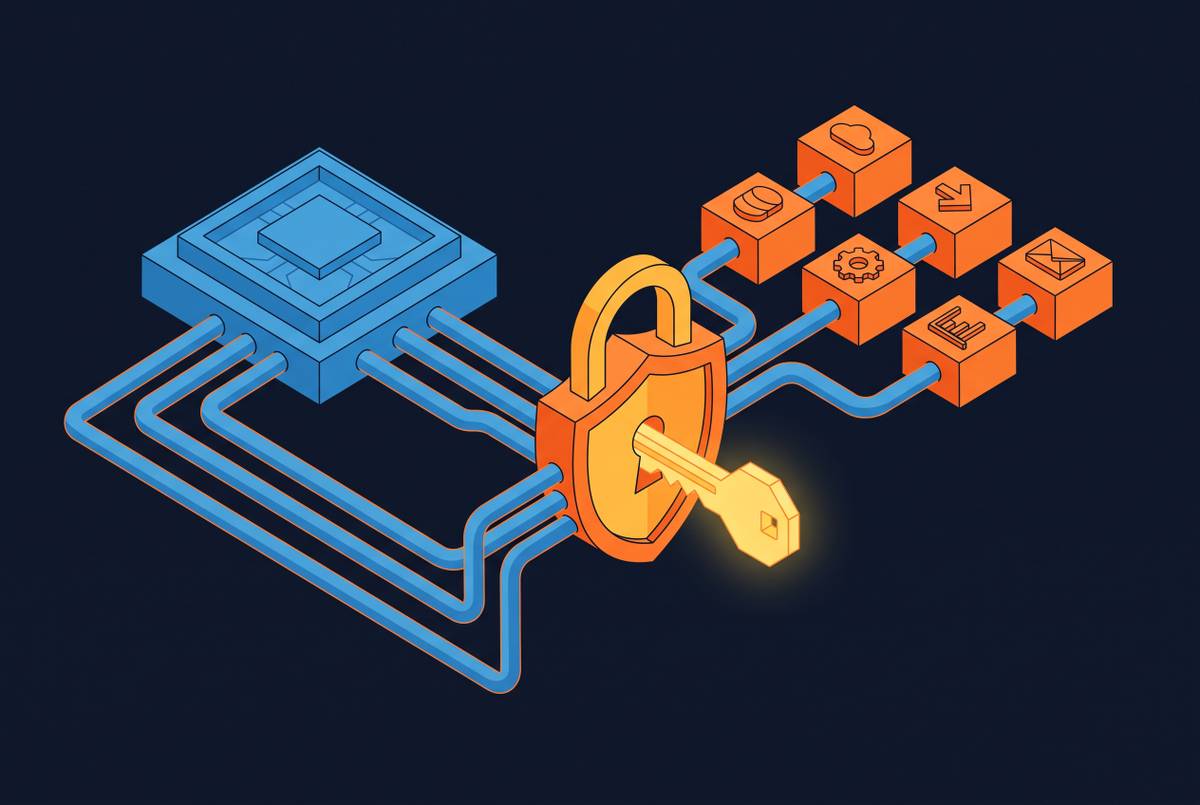
The credential lifecycle makes those role boundaries real at runtime. At session start, the platform should mint a fresh credential carrying only the permissions allowed for that run. The credential belongs to the session identifier. Automatic revocation on session close prevents that authority from surviving the task. A hijacked session remains dangerous, but its credential is bounded by the role and the session’s lifetime.
Credentials should be accessible only within the isolated environment running the session. That environment must bound filesystem paths, outbound domains, available tokens, and the repositories and branches the agent can use. Network allowlisting complements token scope by restricting where a compromised agent can send data. Per-PR environments that are destroyed on merge or close also prevent state from carrying into later runs. Bunnyshell’s environment-per-PR model demonstrates this operational pattern, while Ramp uses Modal Sandboxes for background coding agents that turn changes into commits or pull requests.
Version-controlling role definitions as code in the repository
A repository-controlled YAML file should express the agent’s role, permitted environments, allowed tool registries, and operational limits. Its structure should also include per-agent daily limits, per-task caps, and the action taken when a limit is exceeded. Supported policy choices in the brief include pause_and_alert, terminate, and downgrade_model. An AGENTS.md or CLAUDE.md policy file can describe the tool tiers, review requirements, and fallback behavior that govern the workflow. These files are engineering artifacts that require runtime enforcement.
Version control gives each permission change a named author, commit timestamp, reviewable diff, and revert path. Require code-owner review for role changes as for changes to a deployment pipeline. That review links changes to prompts and tool-registration to the permissions they affect, helping keep the declared role in line with what the agent can do. Campaigns that planted startup commands in hidden.claude/ and.vscode/ directories show why agent configuration needs the same review and protection.
Logging every tool call to a named principal: building the audit trail that makes RBAC provable
A role definition states what should happen, while an audit trail shows what did happen. Each attributable action record needs the agent identity, session credential used, active role, tool call, diff or output, and timestamp. Logging must cover file access, shell commands, PR creation, API calls, and every tool invocation. Summaries cannot replace the granular sequence an incident responder needs to reconstruct a run. Route those records into the enterprise SIEM rather than leave agent activity in a separate log silo.
The audit surface also includes thinking tokens and model reasoning. Periodic access reviews can then use activity records as evidence. Anomaly detection should flag an unfamiliar tool invocation or a call rate that does not fit the task. This gives auditors, compliance teams, and engineering leadership a basis for judging whether the policy holds in practice. Every log entry should resolve to a role, a session, and a named trigger.
Spend controls as access control: why token and cost budgets belong in the role definition
Tool permissions define the kind of action an agent may take, but budgets bound its scale. In one documented rollout with broad access, an annual AI budget was used up within months because that scale was left open. Provider billing alerts arrive after overages, so the enforcement point must be the session or gateway layer. Budget policy belongs in the role definition for the same reason that write permissions do. Both limit the resources an agent can use before it needs more approval.
The YAML policy should set token caps for each session, model-call limits for each task, and retry budgets for tools that fail. It should also define alert thresholds and use pause_and_alert as the default response to exceeding a limit. Downgrade rules should specify whether the agent switches to a lighter model, terminates, or escalates to a human when the remaining budget cannot safely complete the task. A formatter needs a smaller budget than a migration agent that manages a multi-file refactor. Judge those limits by the cost of each task completed successfully, since a cap that is too tight can cost more through retries and escalation to a human.
The propose-and-approve gate: where RBAC enforcement intersects with CI
The model client and tool executor must be separate processes to create a technical enforcement point. In the propose-and-dispose architecture, the client calls the model API outside the sandbox and proposes actions. The executor runs shell commands and tests and edits files inside a locked-down container that has no secrets and limits network access. Neither process holds the full capability set. CI policy then uses the blast radius of each proposed action to decide what approval it needs.
Linting, unit tests, formatting, and read-only sandbox operations can be allowed automatically. New dependencies, changes to existing tests, and edits to build scripts or Dockerfiles require owner review. Credentialed API access and writes outside the repository require human approval with a token minted for that approval. Agents propose protected-branch pushes, merges, tags, package publication, and production deployment, while humans execute them.
Agent PRs must pass the same required checks as human PRs, including code-owner review, coverage thresholds, lint, SAST, and secret detection. License governance belongs at that gate too. The ACRSTEALER campaign shows why secret scanning matters for agent configuration, which can hold the keys an attacker wants. Repository-controlled policy should define the applicable tier and the fallback for requests outside it.
Running this in production: managed infrastructure versus self-hosted tradeoffs for governed agent fleets
Managed infrastructure is the practical path for most teams because credential minting, isolation, audit routing, and budget enforcement carry a substantial operational burden. In this context, managed means that the platform runs isolated sessions, automatically mints and revokes credentials, enforces gateway budgets, and produces tool-call audit records. The platform choice determines which controls the team inherits and which it must engineer. Governance still depends on the actual boundaries provided.
With self-hosting, the team has direct control over the network boundary and credential store. Available isolation technologies include gVisor containers, Firecracker microVMs, macOS Seatbelt, and Linux Landlock. In healthcare or defense settings where the law bars sending code outside the enterprise perimeter, the infrastructure that enforces these rules must stay inside it. Regardless of deployment model, the engineering team should own the version-controlled role definitions and policies that the platform executes. RBAC must cover IDE collaboration, local CLI execution, and asynchronous cloud agents, with the cloud tier carrying the most complex enforcement demands.
An implementation sequence for teams moving from permissive pilot to governed fleet
Begin by inventorying every running agent, assigning a unique identifier and owning team, and ending shared API-key use. Next, define roles by function, including PR reviewer, feature builder, CI triage agent, and migration agent. Specify each role’s tools, environments, and action tiers in repository-controlled YAML. Put code-owner review on those files before expanding the catalog. This establishes who holds authority and where changes to that authority are reviewed.
Then replace persistent credentials with fresh session-scoped tokens and automatic revocation on session close. Add isolated execution environments with filesystem, network, credential, and git boundaries enforced by infrastructure. Send records of tool calls, file access, shell commands, and API invocations to a central store linked to the enterprise SIEM. Establish normal behavior per role so that departures are detectable. This sequence connects the declared policy to runtime limits and observable actions.
Finally, add role-specific token caps, model-call limits, and on-exceed actions, with enforcement at the gateway or platform layer. Require every agent PR to pass secret scanning, SAST, license governance, and code-owner review. Configure approval tiers so that the human checkpoint matches the action’s risk. The success criterion is that every agent action is attributable to a named principal, bounded by a defined role, and visible in the audit trail.